The Southern Renewals Enterprise (SRE) represents an evolution in UK rail infrastructure delivery. Based on the Institution of Civil Engineers & Infrastructure Client Group’s Project 13 principles, the SRE focuses on long-term asset performance, continuity, and early, collaborative decision-making across a diverse renewals programme, covering buildings, civils, signalling, track, electrification, and plant.
The SRE is Network Rail’s collaborative delivery model for the Southern region’s CP7 & CP9 renewals portfolio, bringing partners together into a single, integrated enterprise to improve efficiency and outcomes. The Enterprise combines strategic leadership from the Capable Owner (Network Rail) with delivery through the Southern Integrated Delivery (SID) team – made up of VolkerRail (Track), VolkerFitzpatrick (Buildings & Civils), Octavius (Electrification & Plant), AtkinsRéalis (Signalling & Telecommunications) and Network Rail’s Works Delivery team – supported by a wider supply chain ecosystem. All partners are aligned to shared goals, outcomes and a “win together, lose together” approach, working collectively to deliver better value for passengers and freight.
For Whitfield Consulting Services (WCS), working with VolkerFitzpatrick as the Building & Civils Business Partner within the SRE has provided insight into how this enterprise approach operates in practice. The strengthening of the footbridge at Hamble Station in Southampton illustrates how collaborative working under an enterprise model can enable informed engineering decisions and deliver greater value for money on operational assets owned by Network Rail.
An evolution in delivery
For decades, the delivery of various railway infrastructure projects has been carried out under frameworks and traditional delivery models. The SRE builds on this foundation, applying the principles of Project 13 to create a longer-term, more integrated delivery structure. Rather than operating in silos, civil engineers, contractors, and Network Rail work collaboratively from the earliest stages of a project.
“It’s not a completely new way of working,” says Edwin Enyi-Abonta, Principal Engineer at WCS. “It’s an evolution. While projects under the SRE are delivered to the same Network Rail standards and processes engineers are familiar with, there’s a lot more opportunity for all project stakeholders to collaborate and shape solutions together from early phases. Everyone works as an integrated, single team to deliver valuable outcomes across the entire project lifecycle – working towards the same goal of project success and the long-term performance of the asset – rather than a pure focus on individual remits and work scope.”
The SRE model fosters long term relationships between the stakeholders, encourages practical innovation and productivity gains to emerge naturally, with improvements arising from collaboration and shared understanding of constraints.
Hamble Station footbridge: understanding the challenge
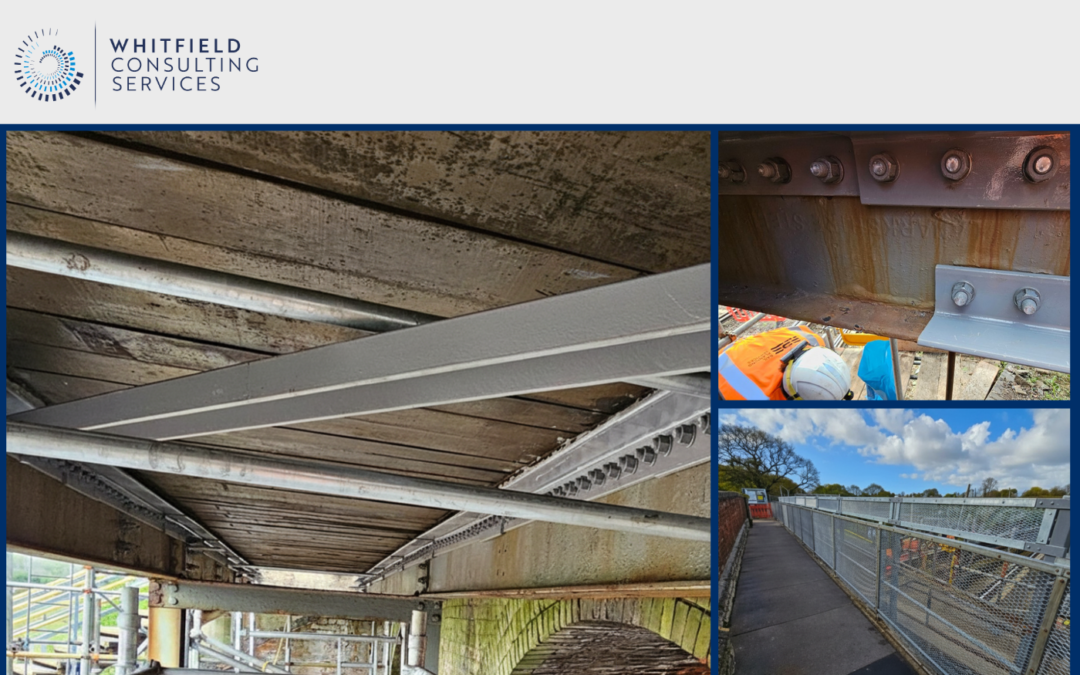
Hamble Station footbridge provides pedestrian access between the two station platforms and therefore plays a key role in day-to-day station operation, allowing station users to transfer between platforms. The two-span metallic footbridge comprises two main RSJ girders connected by three tie members at irregular intervals. Above the girders sits a timber deck with a metallic post and mesh infill parapet on one side and a masonry wall parapet on the other side (which is part of an adjacent road bridge). The footbridge rests on masonry abutments at both ends and is supported centrally over an RSJ column. The footbridge was built at a time that predated modern standards and had deteriorated over time, with corrosion affecting the structural capacity of key parts of the footbridge, the girders in particular. Other aspects like the parapet height were not compliant with modern standards.
Past Network Rail routine inspections had identified that the bridge required intervention. A decision was made to strengthen and refurbish rather than replace the bridge, with the aim of extending the bridge’s service life by 25 years.
“This was a structure that needed urgent action,” Edwin explains. “The challenge was deciding how best to design the necessary repairs to extend the structure’s life while working within the budgetary and site constraints, and ensuring compliance with modern standards.”
WCS was appointed to deliver the PACE (Project Acceleration in a Controlled Environment) 1 and 2 stages of the project under the framework, covering project initiation, development and project selection.
Initially, WCS conducted a desktop study and subsequently attended the site to carry out an Inspection for Assessment (IfA) to ascertain the current condition since the previous review. This informed an Option Selection stage, during which multiple strengthening approaches were developed and discussed with the wider SRE team before a preferred solution was selected.
Some of the options included welded over plates to the top flanges in a top-down construction methodology, which would minimise the constraints on operative access whilst leveraging the existing structure’s geometry for ease of load transfer. One challenge with this option was the requirement for extensive preparation welding, the site welding operation itself, and the complete removal and reinstatement of timber deck units given their age and condition. The other option considered was bolt fixed angle sections into the web of the girders, thus increasing the web / flange cross-sectional areas; this was the preferred option. This solution eliminated the requirement for on-site welding with its associated risks, as well as the need to remove timber decking units. However, some challenges identified included working in confined spaces and the need to work at height, all of which were managed by the contractor on site.
Learn more about PACE in our article that explains how this framework supports all parties in charting the development of a project, from inception to handback.
Designing within operational constraints
“There were many physical constraints which needed consideration,” says Edwin. “The structure itself being within the operational railway environment, there were cable management system (CMS) pipes fixed to it, limited site space to install new strengthening structure, adjacent to a road, and the need to keep the disruption to the station services minimal during the repair works.”
WCS developed a strengthening solution that introduced new steel elements to improve capacity while retaining the majority of the existing primary structure that was still in sound condition. Works included strengthening the main beam flanges with new bolt fixed angle sections, strengthening and extending parapets, and introducing diagonal parallel flange channel bracing between the girders to improve the lateral stability of the structure.
A key design consideration was compliance with current Network Rail requirements around hidden critical elements (HCEs).
“The ability to undertake long-term inspection and maintenance is often a key consideration of any renewal or strengthening scheme,” Edwin notes. “We were careful not to introduce HCEs, i.e. elements that could be deteriorating but that cannot be inspected in the future due to them being hidden from view. For example, in some instances, the design specified welded connections over bolted connections to SHS posts, to eliminate that risk.”
Parapet heights were also increased to meet modern safety standards, improving passenger safety and bringing the asset in line with modern safety expectations.
Temporary works informed by collaboration
Temporary works were key to the success of the Hamble Station project; WCS developed the temporary works design.
“Temporary works are often where risk concentrates,” says Edwin. “Because we were working collaboratively, we could step in and offer a simple and effective approach when SRE required it as constructability had been kept in mind from the start when the design proposals were developed.”
The proposal involved supporting parts of the existing parapet that were required to be modified or strengthened, on those elements yet to be strengthened, which meant a commensurate increase in bay area and thus increased loading arising from wind action. To mitigate, the capacity of the existing deteriorating parapet was assessed based on the lower forecast wind speeds – for the short duration of the works – rather than the basic wind velocity in Eurocode 1 Part 1-4, which is for a 1-in-50 year return period. The SRE was also instructed to institute a wind management plan on site, to constantly monitor wind speed using an anemometer and a mitigation action plan for when the threshold was exceeded.
“Using short-term weather data made sense for this project and is consistent with codes of practice for temporary works,” Edwin explains. “The plan and proposal WCS put forward gave the SRE confidence and allowed them to focus on safe, efficient delivery.”
The resulting approach has since been recognised as one that could be replicated on many other footbridge strengthening schemes.
What the enterprise model enables
While the technical challenges at Hamble were typical of rail renewals, the way they were addressed reflects the value of the SRE approach.
“Ourselves as designer, VolkerFitzpatrick as the SRE’s B&C business partner, and the Network Rail project engineer were all involved from an early stage,” says Edwin. “That meant design development, buildability and assurance were considered together throughout the project lifecycle.”
Looking ahead
As the Southern Renewals Enterprise continues to evolve across CP7 and into CP8, the focus on collaboration, early engagement, and shared responsibility is expected to deliver lasting benefits across the network. WCS is continuing its work on a number of projects within the SRE programme, including platform refurbishments at Bexley Station and Elephant & Castle Station.
For further insight into how WCS applies a collaborative, experience-led approach across infrastructure projects, including practical strategies for constructability, risk mitigation, and cost efficiency, read our article: How partnering with seasoned civil engineering consultants drives project success in Rail and Power & Energy.
If you’re looking for a dependable partner for your next infrastructure project, contact WCS to see how we can support you. Get in touch