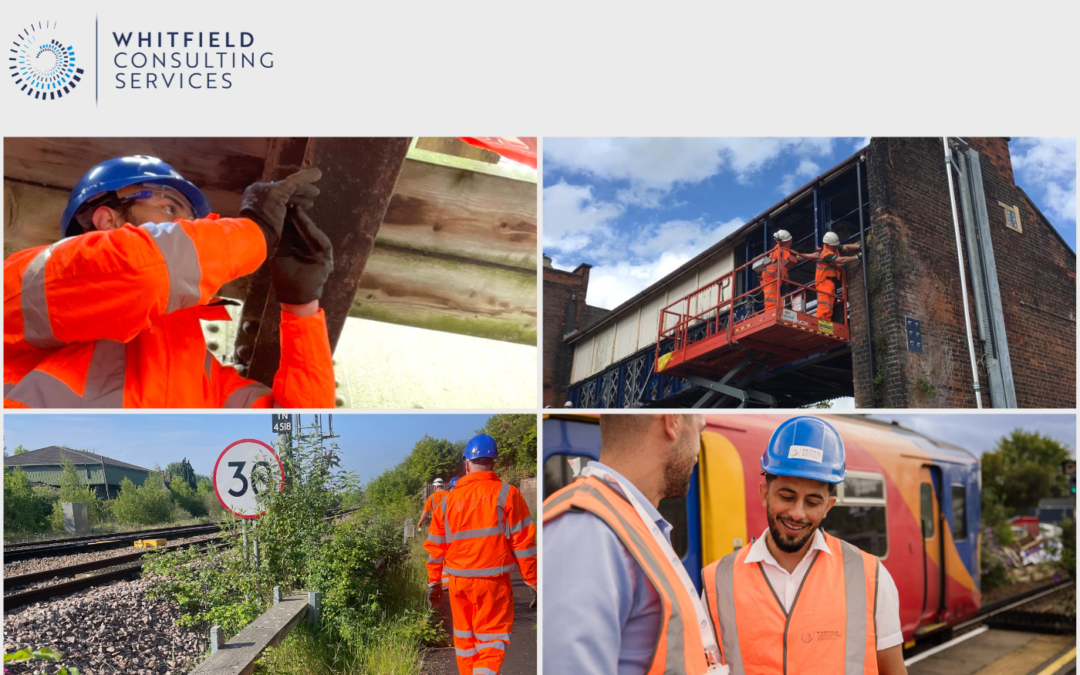
Across the rail network, localised rail civil engineering interventions are regularly undertaken to maintain railway infrastructure, address structural defects and extend the operational life of critical assets. While the environmental impact of any individual project may appear modest, the cumulative effect of these activities is substantial.
In this article, Pyei Pyei Aung, Civil/Structural Design Engineer at Whitfield Consulting Services (WCS), explores how targeted repairs, temporary works design and asset-life extension strategies can improve sustainability across railway infrastructure projects. In two recent projects, engineering decisions by her team resulted in an estimated 30% reduction in construction activities compared to alternative solutions, alongside corresponding reductions in material consumption and associated carbon emissions.
“For many rail projects, sustainability is increasingly being assessed alongside cost, programme and technical performance,” says Pyei Pyei. “Clients and asset owners are looking for engineering design solutions that minimise embodied carbon, reduce material consumption and maximise the value of existing assets.”
Small projects, significant impact
“The rail sector’s sustainability ambitions are often associated with major enhancement programmes, electrification schemes and large-scale renewals, but small projects consume materials, equipment, energy and water in a similar manner to larger projects,” says Pyei Pyei. “The impact of small projects should be given the same consideration as those of major projects, with efforts made to minimise resource consumption, waste generation, and environmental impacts wherever possible.”
The principles underpinning Network Rail’s Control Period 7 (CP7) objectives – improving efficiency, reducing carbon emissions, minimising waste and maximising value from existing assets – are equally relevant to maintenance and repair projects.
Extending asset life through targeted repair
One of the most effective ways to reduce embodied carbon is to maximise the value of existing assets. Before replacement is considered, engineers should evaluate whether structures can be safely retained, strengthened or repaired.
“Engineers can assess the residual capacity and remaining service life of existing structures through detailed inspections and structural evaluations,” says Pyei Pyei. “Based on these assessments, they can determine whether the structures can be retained and repaired, rather than being replaced, thereby reducing material consumption, waste generation, and environmental impact.”
WCS applied this approach recently on a project that required repairs to a masonry rail arch bridge in south London addressing defects in the existing steel deck plate adjacent to the walkway of a live railway bridge. The repair was required due to the presence of two openings identified within the existing deck plate, which formed part of the access walkway.
Rather than removing and replacing the affected section, WCS developed a localised repair solution that retained the existing steelwork and restored structural capacity through the installation of a new steel repair plate. This avoided unnecessary removal of serviceable materials while reducing construction activities, possession requirements and associated waste.
The repair plate was optimised to 10mm thickness based on the imposed loading criteria.
“The optimisation process minimises material usage while maintaining the required structural performance,” explains Pyei Pyei. “Limiting the plate size to only the affected area avoids the unnecessary use of additional materials and contributes to a more efficient and resource-conscious design solution.”
To support long-term performance, the repair incorporates a protective coating system designed to enhance durability and reduce future maintenance requirements.
Discover how WCS applied sustainability principles on the Downs Park Road Overbridge project, delivering an approximate 25% reduction in embodied carbon and a 30% cost saving compared with alternative solutions; click here.
Reducing environmental impact through temporary works design
“Although temporary works are typically in place for a much shorter duration than the permanent works, they can account for a significant proportion of the resources consumed during construction, making their efficient design and management essential for improving project sustainability,” says Pyei Pyei.
This principle was demonstrated on a recent project, where a defective brick parapet wall to an existing railway viaduct in south London required demolition and reconstruction while maintaining support for an operational cable trough.
Alternative solutions included scaffold-based support arrangements and bespoke cantilever steelwork. While technically feasible, these options would have required greater material inputs and additional construction activities.
Instead, WCS specified a proprietary davit arm system with counterweights.
“The use of a proprietary modular system means the equipment can be assembled, dismantled and reused on future projects,” says Pyei Pyei. “This approach minimises material consumption, reduces construction waste and avoids the need for bespoke temporary steelwork.”
The reusable system reduced embodied carbon associated with temporary works while providing a safe and efficient means of supporting the live cable infrastructure throughout the programme.
When temporary works are overlooked during early design stages, projects risk avoidable delays, increased costs, or complicated redesigns. Read more in our spotlight on temporary works for bridges & structures.
Sustainability through engineering decisions
Looking ahead, Pyei Pyei sees the greatest opportunities for improving sustainability outcomes in the early decisions made around reuse, construction methods and material specification.
“Retaining and reusing existing structures wherever feasible should always be considered before full replacement,” she says. “Off-site fabrication can improve efficiency and reduce carbon emissions, while low-carbon concrete, recycled materials and low-emission plant can further reduce the environmental impact of project delivery.”
This means challenging assumptions around replacement, prioritising off-site fabrication where appropriate, and considering lower-carbon materials, vehicles, plant and equipment.
The right partner for your project
For organisations delivering rail civil engineering and railway infrastructure projects, achieving sustainability objectives will depend on engineering decisions made across both major programmes and day-to-day maintenance works.
By extending asset life, reducing temporary works impacts and optimising material use, project-level decisions can deliver cumulative benefits across the wider rail network.
WCS combines rail sector experience with an agile, collaborative approach, supporting clients with civil engineering solutions that meet safety, regulatory, technical and sustainability requirements.
For guidance and support on your rail projects, contact WCS to learn how we can help implement civil engineering solutions that meet your goals. Get in touch.