Effective bridge and civil structures design depends on more than the performance of the structure itself. Each asset sits within a wider system of geotechnical, hydraulic, operational and construction constraints that must be understood collectively if the design is to perform as intended.
Whether supporting a highway, crossing a railway or forming part of a major Power & Energy scheme, the structural solution must respond to factors including ground conditions, drainage and flood risk, utilities, access, temporary works, construction methodology and future inspection and maintenance.
For Whitfield Consulting Services (WCS), effective technical leadership means understanding how these constraints interact and coordinating the different disciplines involved before individual design decisions become fixed. This ensures the final solution is safe, compliant, constructable, and durable.
“Strong technical leadership goes beyond reviewing calculations and design outputs,” explains Mohamed Omar, Principal Structural Engineer at WCS. “It is about identifying risks early, understanding the interfaces between disciplines and making sure the design develops into something that is safe, buildable and maintainable.”
Identifying technical risk early
Experienced project leadership can make a significant difference before detailed design begins. No two bridge or civil infrastructure schemes are identical, but experienced engineers can recognise similarities with previous projects, challenge assumptions and identify where further investigation is needed.
From the early stages of a project, WCS put together a responsibility matrix to identify and communicate potential technical challenges, site limitations, and constructability considerations. This helps the team understand where further investigation or specialist input may be needed before key design decisions become fixed.
Jeremy Barnes, Technical Director at WCS, explains:
“Experience helps you anticipate the outcome before you reach the end of the project. You recognise where you have seen similar issues before and can use that knowledge as a check on the design.”
This was demonstrated on one recent transmission infrastructure project, where WCS was appointed to deliver detailed civils design for access road, bridge and associated enabling works serving a new substation.
WCS identified that further geotechnical investigation was required, and the additional information revealed significantly poorer ground conditions than had initially been assumed. This directly affected both the foundation arrangement and structural form of the bridge. The foundation solution became more substantial, while the bridge changed from an integral to a semi-integral arrangement supported on bearings.
“For bridges, the structural and geotechnical design are very closely linked,” says Mohamed. “You cannot always separate one from the other particularly with integral bridges. If the ground conditions change, the foundation changes, and that can then influence the structural form of the bridge.”
Identifying this risk early also enabled WCS to help the client understand the potential cost, programme and construction implications before the design progressed further.
Coordinating constraints across disciplines
The same transmission infrastructure scheme illustrates why bridge design must be considered as part of the wider infrastructure project.
Alongside difficult ground conditions, the access infrastructure had to accommodate abnormal loading requirements, flood risk, utilities, overhead transmission infrastructure, and restricted construction corridors.
These requirements influenced one another. Flood modelling informed the bridge and access levels, while overhead line restrictions influenced piling methodology and bridge installation. At the same time, the highway and bridge designs had to progress together so that access, structural depth, and construction sequence remained coordinated.
“A lot of project risks emerge at the interfaces between disciplines,” explains Mohamed. “That is why bringing people together regularly can be more valuable than looking at individual technical packages in isolation.”
WCS worked closely with the client alongside specialist designers, contractors, fabricators and third-party asset owners covering piling, ground improvement, flood modelling, swept path analysis, Road Safety Audit, utilities, fabrication, and temporary works.
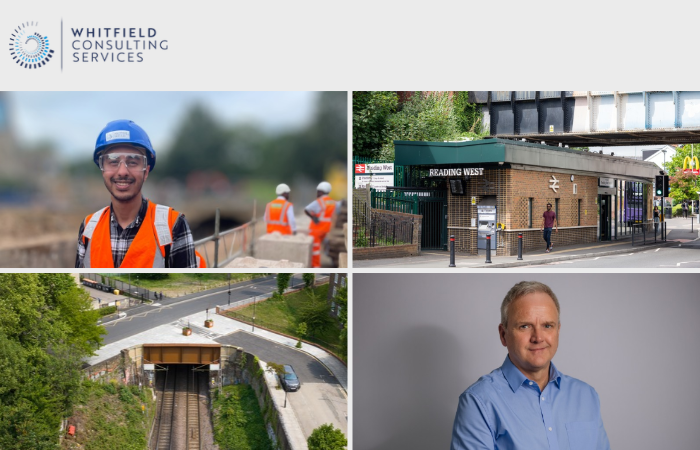
That same principle of integrated design applies across WCS’s rail work. On Reading West Station, WCS provided full civil and structural engineering design services, supported by 3D BIM analysis, for a new ticket hall and gate. The project required structural design to be coordinated with the existing station environment, the existing rail overbridge, passenger facilities, and the wider construction programme. WCS also managed the architectural service through our supply chain.
Designing with construction in mind
A structurally compliant design still needs to be practical to build. Early coordination with contractors allows construction sequence, access, lifting methodology, temporary works, and procurement constraints to influence the design while there is still an opportunity to make changes efficiently.
On the transmission infrastructure project described above, WCS worked with the client throughout design development to understand how the bridge would be installed, how temporary and permanent works would interact and how construction constraints would affect delivery.
“The temporary works and permanent works can affect each other,” says Mohamed. “It is not always about saying one party owns one design and somebody else owns another. You have to work together to arrive at the right solution.”
WCS applied the same thinking to the Downs Park Road Overbridge reconstruction in Hackney. Early contractor involvement, constructability reviews, and a trial erection of the prefabricated bridge elements helped reduce installation risk ahead of a tightly constrained rail possession.
The project also demonstrated how temporary and permanent works can be considered together. Elements of the permanent design were used to simplify construction activities, reducing redundant temporary works, material use and time on site.
Click here to read the full case study.
Verifying design performance
Technical leadership also includes checking that design assumptions translate into actual structural performance.
On the transmission infrastructure project, WCS used detailed analytical modelling to assess the behaviour of piled foundations in complex ground conditions. Subsequent testing of installed piles at the site showed a close correlation with the predicted design performance.
Detailed analysis modelling was also used to predict differential movement between bridge elements during assembly, with measurements taken during trial erection closely matching the predicted behaviour.
This approach is reflected elsewhere in WCS’s portfolio. On Downs Park, 3D structural modelling and design tools were supported by hand calculations and bespoke spreadsheets to independently verify the analysis and confirm the behaviour of the structure.
For WCS, digital modelling must go hand-in-hand with sound engineering judgement rather than simply replacing it.
As design tools, materials and construction methods continue to develop, experienced engineering judgement provides an important check alongside these advances. Previous project experience helps WCS engineers interrogate outputs, recognise when results do not align with expected structural behaviour and assess whether new approaches are appropriate for the specific asset and project conditions.
Balancing whole-life performance
Experienced project leadership also means looking beyond construction.
Safety and compliance remain fundamental, but durability, maintainability, sustainability, programme and cost all need to be considered as part of the same decision-making process.
WCS uses optioneering to compare potential solutions against relevant criteria, helping clients understand the implications of different approaches before a preferred design is selected. This can include considering embodied carbon alongside factors such as material quantities, construction methodology and whole-life maintenance requirements.
Whole-life performance can also influence material selection. On one bridge project, future repainting would have been difficult because of the structure’s location over a watercourse. Weathering steel was therefore selected to reduce future maintenance requirements, while the new structural elements were designed for a 120-year service life.
“The cheapest capital solution is not necessarily the best solution over the life of the asset,” says Mohamed. “You have to think about how it will be inspected, maintained and repaired in the future.”
At Downs Park Road, retaining the existing bridge abutments and optimising the replacement structure helped reduce material use and construction activity while providing a durable long-term solution. These design decisions also delivered a measurable carbon benefit.
Carbon calculations undertaken for the project showed that WCS’ design choices reduced emissions by 25%, equivalent to approximately 88.70 tonnes CO2e. The reduction was achieved through a combination of retaining existing elements, material optimisation, the use of precast elements and FRP, and reducing construction activity.
The WCS approach
WCS’s bridges and civil structures capability combines structural engineering with in-house highways, drainage and geotechnical experience, supported by specialist partners where required.
This experience spans rail, Power & Energy and wider infrastructure, from new access bridges and major bridge reconstruction to station structures, strengthening, repair and reactive works.
Jeremy explains: “WCS can provide the multidisciplinary input these projects need, while still retaining the flexibility to bring the right people together quickly.”
This is supported by WCS’s structured design management and internal assurance processes, with appropriately experienced project leads and levels of checking that reflect the complexity and technical risk of each scheme.
Technical development is supported through internal and external CPD and WCS’s structured approach to developing engineers, including training aligned with the Institution of Structural Engineers and Institution of Civil Engineers.
For clients, the value of strong technical leadership lies in bringing these elements together: identifying risk early, understanding interfaces, coordinating design with construction, and making decisions with long-term asset performance in mind.
By approaching bridge and civil structures design in this way, WCS helps clients deliver assets that are safe, compliant, constructable, maintainable, and durable throughout their intended design life.
To discuss how WCS can support your bridges and civil structures project, please contact our team.