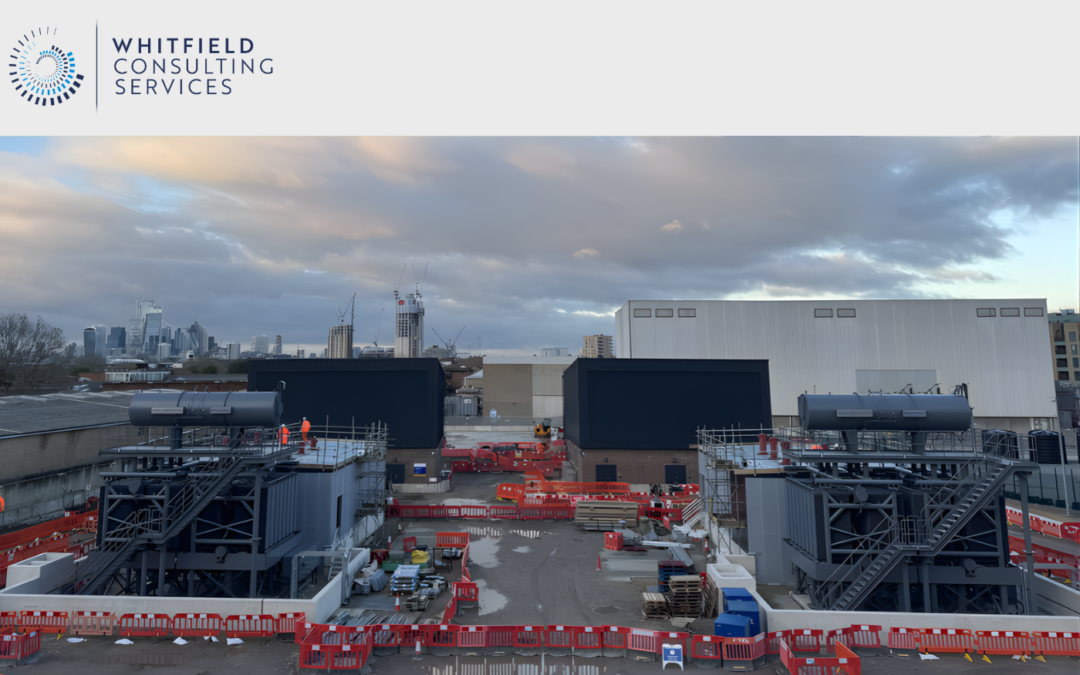
The London Power Tunnels 2 (LPT2) project represents a major upgrade to the city’s underground electricity network. Designed to replace older power routes beneath London roads, the scheme will reduce maintenance disruptions and accommodate rising energy demand. It involves the construction of 32.5 km of 3 m-diameter underground tunnels, connecting four existing and two new substation sites via high-voltage cables that form a critical part of the city’s transmission system.
Within this complex infrastructure programme, Whitfield Consulting Services (WCS) was appointed by Linxon as the lead civil designer for the New Cross and Bengeworth Road substations.
In this case study, Victor Lupusor, Principal Structural Engineer at WCS, talks us through how the team overcame key challenges on these sites, balancing complex urban constraints, cost considerations, and safety requirements. Victor led the WCS team, managing civil design across foundations, cable containment, access roads, drainage, lighting, fencing, and the assessment of reusable infrastructure.
Challenge: Working in a constrained urban environment
The substations were located in restricted urban corridors, with very limited space for construction vehicles and materials. Existing underground services created uncertainty that could impact cable routing, foundation layout, and construction sequencing. New Cross was an existing operational substation and remained live throughout the works, requiring designs that could be implemented safely without interrupting the electricity supply, while Bengeworth Road was a new substation that had not yet been energised.
Technical challenges included:
- Complex cable routing requirements due to multiple circuits and limited space.
- Foundation design constraints driven by high-voltage loads and site limitations.
- The requirement for bespoke construction elements, as standard precast troughs could not accommodate the cable layout.
- Safety and live substation operation considerations requiring careful sequencing and protective measures.
“Services were one of the biggest challenges. Close collaboration with the site team enabled a programme of utility surveys and trial pit investigations, improving our understanding of existing assets and informing service diversions or protection measures where relocation was not feasible. We also designed new access roads to accommodate operational traffic and provide suitable access for emergency vehicles,” notes Victor.
Civil design solutions
WCS developed civil designs that were directly responsive to each of these challenges:
- Cable containment and routing: WCS’s civil design scope included cable containment for the proposed 132kV and 400kV cable routes coming out of the tunnel. This required careful coordination with the cable system designer and the use of Autodesk Forma for clash detection and to ensure constructability.
- Foundation refinement: Initial designs suggested one-metre-deep foundations. WCS optimised these to 0.5 m, reducing concrete volumes, lowering costs, and decreasing programme risk while maintaining structural integrity.
- Custom in-situ troughs: Standard precast solutions could not accommodate the complex cable layout. WCS designed bespoke reinforced concrete troughs with fireproof covers, ensuring the cables could be installed safely and accurately.
- Live substation operation: Sequenced construction and safety measures were embedded in the designs, allowing ongoing operation of the substations during installation and reducing operational risk.
Victor explains: “We applied independent engineering judgement to optimise foundations and cable routing, reducing risks and ensuring that all elements could be safely installed on a live site.”
These measures provided Linxon with constructible, cost-efficient designs that reduced programme risk and gave confidence for safe installation in a densely constrained urban environment.
Supporting cost efficiency and sustainability
With tight programme deadlines and multiple contractors managing different packages, efficiency and cost management were critical. Victor notes:
“Collaboration with other disciplines and contractors helped us to identify practical efficiencies, resolve interfaces and reduce material use without compromising safety or performance.”
Design choices that helped to optimise cost and resource efficiency include:
- Foundation optimisation: Reducing foundation depths saved concrete use, cost and programme exposure while retaining the required structural performance.
- DH15 reuse assessment: WCS undertook a National Grid Design Handbook 15 (DH15) assessment, which concluded that four existing Cable Sealing End steel support structures at New Cross were suitable for reuse. Reuse eliminated the need to demolish the existing structures and erect replacements, reducing high-risk activities including working at height, heavy lifting and the use of demolition equipment. The carbon assessment estimated a 96% reduction in embodied carbon compared with the new-build option. By minimising new material use and preserving existing infrastructure, the team reduced embodied carbon and improved overall sustainability.
Outcome: Constructible, safe, and cost-effective design
Through agile design, early risk identification, and integrated collaboration, WCS delivered civil designs that:
- Enabled safe installation of high-voltage cables and equipment in a dense urban environment.
- Reduced construction costs and material use through foundation and trough optimisation.
- Maintained programme momentum and safety on live substations.
- Optimised the reuse of existing infrastructure while meeting health, safety, and sustainability objectives.
- Enabled effective real-time collaboration across multi-disciplinary design teams using digital platforms to inform the design process and address interfaces.
Victor reflects: “This project pushed me to develop as an engineer. The complexity, sustainable approach, problem-solving, and health and safety considerations have all contributed to a high level of professional growth and pride in contributing to London’s infrastructure.”
Power & Energy experience
The London Power Tunnels 2 substations demonstrate WCS’s ability to manage complex urban challenges while balancing safety, constructability, and cost efficiency. Beyond this project, WCS applies the same approach across the Power & Energy sector, drawing on experience from large-scale infrastructure and renewable energy projects such as the largest substation project in the UK.
Key aspects of WCS’s approach include:
- Practical, buildable design: Ensuring that civil solutions can be implemented safely on site, even in constrained or live operational environments.
- Independent engineering judgement: Challenging assumptions, optimising foundations, cable containment, and structures to reduce programme and material risk.
- Multidisciplinary collaboration: Close integration with electrical, structural, and contractor teams to identify clashes and coordinate interfaces before construction.
- Health, safety, and sustainability: Designs account for live operations, protective measures, and long-term environmental impacts, including reduced concrete usage and reuse of existing infrastructure.
- Programme and cost efficiency: Agile design processes allow WCS to respond quickly to on-site queries, optimise resource use, and support clients in meeting tight delivery schedules.
“Our team brings technical design capability as well as hands-on experience to support construction teams on the ground,” says Victor. “On every project, we apply our company values – agility, collaboration, and experience – consistently, always aiming to help our clients reduce risks and costs while supporting programme delivery.”
WCS is proud to support the projects that are powering the UK and Ireland’s transition to renewable energy:
- See our downloadable case study brochure for the Power & Energy sector, detailing projects including Dogger Bank, the world’s biggest offshore wind farm.
- Read our article to learn more about the role civil engineers are playing in delivering BESS projects.
To find out more about our Power & Energy experience, click here. Or, if you would like to discuss your next project, please get in touch by emailing power@wcs-consult.co.uk or calling +44(0)20 3581 7847.