According to research by Enginuity, around 50% of engineering and manufacturing SMEs report skills gaps or shortages, highlighting the importance of attracting and developing the next generation of engineers.
Addressing this challenge requires collaboration between education and industry, giving young people opportunities to explore engineering careers and develop practical skills.
At Whitfield Consulting Services (WCS), we support this through work experience and student placements, including our involvement in the Surrey-ICE Scholarship scheme. These opportunities introduce young people to civil and structural engineering, helping them develop technical and professional skills while gaining experience of live infrastructure projects.
Celine Mahfoud, Civil and Structural Engineer at WCS, helps coordinate our work experience programme. Here, she explains how students gain practical engineering experience, develop their skills and confidence, and bring fresh perspectives to the team, while highlighting the importance of inspiring the engineers of the future.
Introducing young people to engineering
For school and college students, engineering can be difficult to picture as a career. Our work experience programme offers an opportunity to explore different disciplines and understand what engineers do day to day.
Typically lasting one week, the programme includes practical sessions led by WCS engineers covering structural design, drainage, highways and sustainability. Students also gain an introduction to digital design tools, including Computer-Aided Design (CAD) and Building Information Modelling (BIM), helping them understand how engineers develop, visualise and coordinate designs.
One of our recent week-long work experience students shares, “The whole team have been so welcoming and willing to help me learn more about their professions and skills. Overall, the whole experience has been perfect for helping me gain more knowledge and providing me with real insight into how a company working at the heart of the construction industry operates.”
Students are encouraged to get involved rather than simply observe, applying engineering principles through activities such as constructing physical models of bridges to better understand the structural behaviour of different members, testing structural frames under different loads and developing solutions to design challenges.
Celine explains: “It’s really good to give them a bit more exposure to what engineering is and what we do. We cover civil and structural engineering, as well as CAD, so they get a chance to explore what it means to produce drawings and models, which they really enjoy.”
Celine also tailors activities to students’ interests, giving those particularly interested in bridges, buildings or other areas an opportunity to explore these subjects in greater detail.
One exercise challenges students to consider whether an existing building should be demolished and replaced or adapted for future use.
“I encourage them to challenge the brief and ask, why do we need to demolish this? Why can’t we keep it and modify it or retrofit it?” says Celine. “One student, for example, proposed rooftop gardens and green spaces on balconies, considering how the design could benefit both the environment and the people using the building.”
Students research potential solutions and present their recommendations at the end of the week, developing their communication, presentation and problem-solving skills alongside their technical understanding.
Another student highlights the variety of engineering disciplines they explore during their week-long placement: “I really enjoyed the work experience. I loved that I got to both work and learn about different aspects of civil engineering, like drainage, structures and sustainability.”
Gaining experience on live engineering projects
For university students, placements offer the opportunity to apply academic knowledge in a professional engineering environment.
Through the Surrey-ICE Scholarship scheme, a partnership between the University of Surrey, the Institution of Civil Engineers (ICE) and industry, WCS provides eight-week and year-long placements.
Recently, two students completed year-long placements, while four others joined WCS for eight weeks. Two of those students subsequently returned in September 2026 to begin year-long placements.
“It’s really nice to see students come back for their year-long placements after spending eight weeks with us. They’ve gained more knowledge through their university studies, so they can build on what they’ve already learnt, take on more detailed work and additional responsibility, and get more involved in projects as their knowledge and confidence develop,” says Celine.
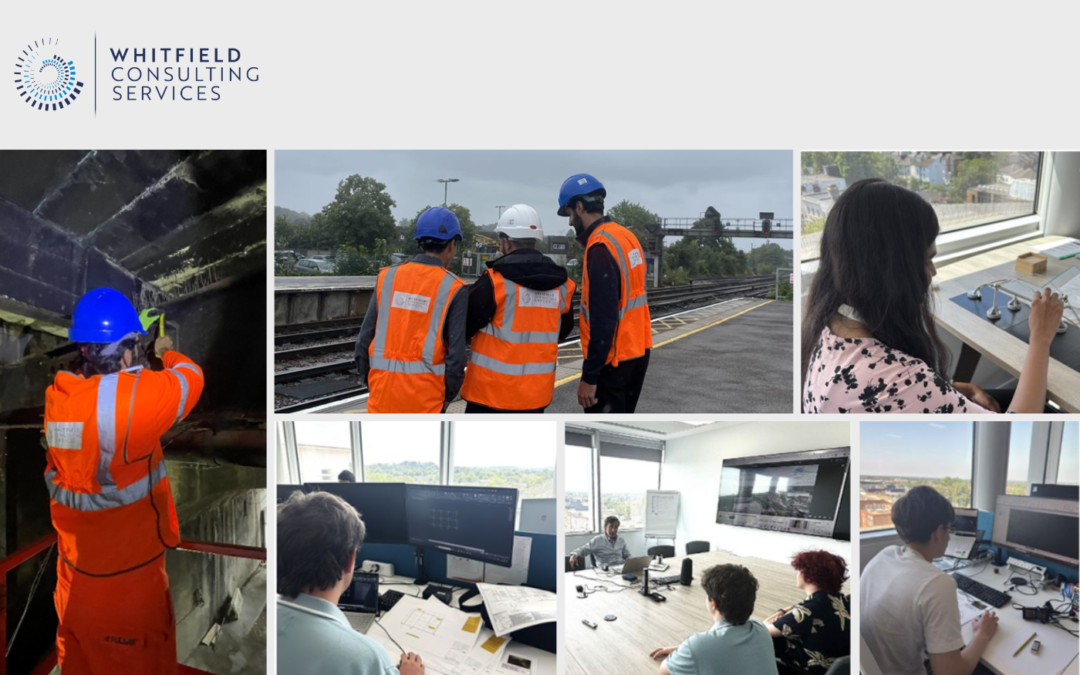
Working alongside experienced engineers, students contribute to projects across Rail and Power & Energy, undertaking activities such as carrying out engineering calculations, producing drawings and developing design risk assessments.
Where appropriate, students also attend site visits under supervision and participate in preparing site visit risk assessments and site visit reports. Through this, they gain an understanding of how engineering designs are developed and implemented in practice.
Celine explains: “They get exposed to what it’s like working on a live project and the day-to-day life of an engineer. Every day is different, and they learn how to adapt to changes and challenges.”
Celine recalls how one student began seeing familiar surroundings differently after his placement:
“One of our students mentioned that when he was taking the train home, he saw a substation and found himself genuinely interested in taking a closer look. On a normal day, he would have simply overlooked it. Another day, he was walking past a train station and recognised something we’d been talking about at work.”
Such experiences help students connect their academic knowledge with the infrastructure around them and discover potential career pathways.
One year-long placement student emphasises the value of contributing to live projects and seeing engineering work put into practice:
“I appreciated the feeling of working like a real civil engineer, doing work that directly impacts the outcome of a project. It was very useful to have the opportunity to be able to visit site.”
Learning and developing together
Throughout their placements, students receive guidance from a designated line manager and support from the wider WCS team.
Celine shares: “Students are encouraged to attend continuing professional development (CPD) sessions and technical training, and to explore membership and professional development pathways through the ICE and the Institution of Structural Engineers (IStructE). It’s a great opportunity for them to develop their professional skills, both technically and personally, and to understand the difference between being at university and being in a workplace.”
Students undertaking longer placements also value the opportunity to take on meaningful responsibilities and contribute to significant infrastructure projects. As one student explains:
“Even though I’ve only been at WCS for six months, I’ve already participated in some of the largest projects in the UK and even had the opportunity to work on my own project.”
The benefits also extend to WCS’s engineering teams, with students contributing fresh perspectives and ideas.
Celine adds, “They bring new ideas, thinking outside the box and a different perspective on things. It’s very useful to see both sides – someone who has years of experience and someone who is very fresh – and how they discuss projects and the things they might notice.”
Inspiring future engineers
With the engineering sector continuing to face skills shortages, providing early exposure to the profession is an important part of encouraging future talent.
WCS regularly engages with schools through careers fairs, presentations and outreach activities, alongside its university partnerships and placement programmes.
For Celine, helping more young people, particularly girls, recognise the opportunities available within engineering is especially rewarding. She explains:
“I didn’t get this kind of opportunity myself, so I feel like it’s really valuable that we are able to offer it to others. I really like inspiring younger girls to consider engineering as a career. At first, when you mention engineering, they might not think it’s for them. But once you explain what we do and give them an insight into what the job actually involves, you can see their attitude change. They start thinking, ‘Oh, maybe, why not?’”
Through our one-week work experience placements, WCS aims to introduce young people to the world of civil and structural engineering, giving them an insight into the profession and helping them explore whether it could be a future career.
For those undertaking longer placements, the focus is on gaining hands-on experience from day one. Working closely with experienced engineers and contributing to live projects, students can begin developing their technical knowledge and practical skills, taking their first steps towards a career in engineering and, ultimately, professional chartership.
Find out more about careers and opportunities at WCS.