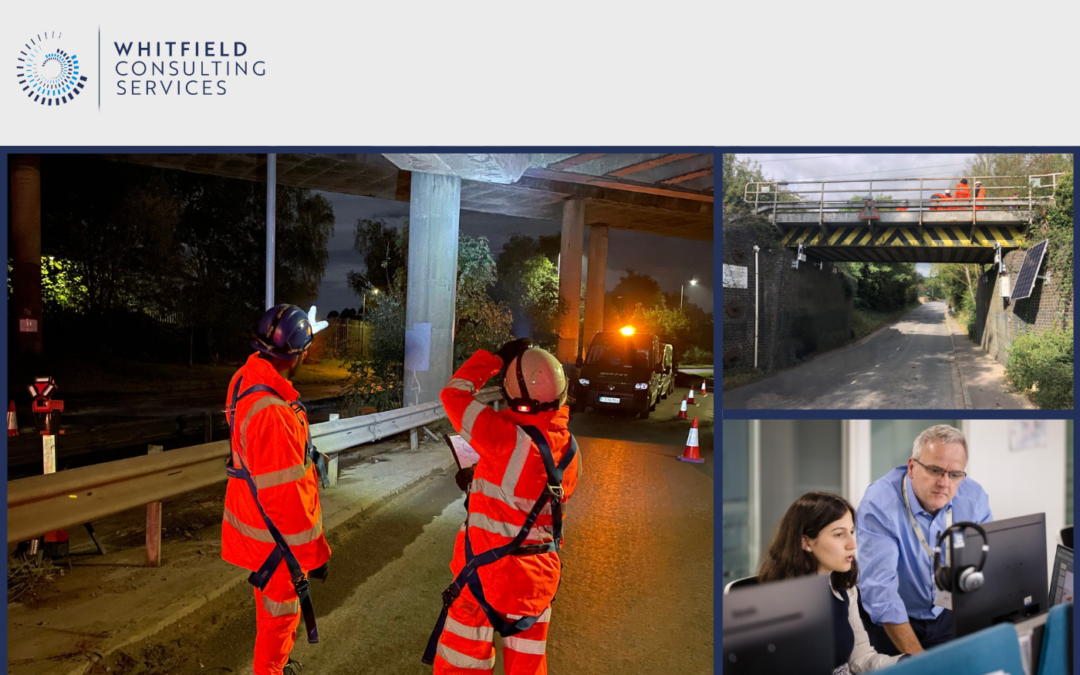
Unexpected asset deterioration, bridge strikes, ground movement, flooding, scour, fires and other incidents can all create a need for engineering input at very short notice. In these situations, experience is essential to quickly understanding the problem, identifying immediate risks and determining the most appropriate response. The priority is to make the railway safe and minimise disruption, while ensuring that any repairs or temporary measures meet established engineering standards and assurance requirements.
Whitfield Consulting Services (WCS) regularly supports rail contractors delivering emergency maintenance and reactive civil and structural works. Technical Director Jeremy Barnes and Principal Engineer Edwin Enyi-Abonta explain how the team combines rapid technical assessment with practical engineering solutions, without compromising the checks and approvals essential to safe railway operations.
Responding to an unexpected problem
An urgent rail requirement is generally one where an unforeseen event has affected, or has the potential to affect, the safe operation of the railway.
“It could be an unplanned disruption due to an incident such as a bridge strike, or an unanticipated environmental factor such as subsidence, embankment instability, scour, fires or higher temperatures,” explains Edwin. “Emergency and rapid response can be needed at any time, so our team has to be on call through the night and at weekends.”
WCS’s reactive rail experience covers a broad range of requirements, from vehicle impacts affecting rail and road bridges and structural strengthening or repairs through to temporary works supporting wider incident response.
Unlike planned works, where passengers can be warned and alternative arrangements prepared in advance, an unexpected incident can result in immediate restrictions or closure of part of the railway until its condition is understood.
“The impact on travel can have a significant ripple effect throughout network operations,” Edwin continues. “But ultimately the safety of passengers and the safety of the line are paramount. Erring on the side of caution is recommended until the incident has been investigated and the impact on infrastructure understood, rectified and the railway is deemed safe to be re-opened to railway traffic.”
The required response depends on the severity of the problem, the asset involved and its operational importance and how quickly action is required. “On reactive frameworks, we have to work to agreed response times and remits,” says Jeremy. “For the most urgent requirements, our team is available within two hours, while other works may allow a 24-hour response.”
Engineering assurance still applies
The need to move quickly does not change the engineering standards that have to be met.
“The design assurance and technical approval processes are there to ensure the highest standards of safety,” says Edwin. “With emergency works there is usually a time constraint, because the aim is to keep disruption to a minimum, but the same review and assurance process still applies, albeit at a more rapid pace.”
Jeremy adds: “Regardless of the time pressures involved, the assurance process remains the same. All work goes through WCS’s own internal design management and checking procedures as well as the requirements of the client and Network Rail.”
The quantity and quality of information immediately available at the outset can also vary significantly.
“Some responses will need a site visit and inspection,” Jeremy explains. “On others, it may be that the site team can relay everything we need through sketches, photographs or video call. We can then progress the design work from that information.”
Working with experienced engineers who can determine what information is essential can save valuable time and ensure the design is right the first time.
Mobilising a multidisciplinary team
One recent urgent rail project demonstrates how quickly that process can need to happen. WCS was asked to provide temporary works design for a haul road and crane working platform to support heavy lifting operations as part of a wider incident response on the railway.
The requirement was immediate.
“I received the initial call at around 8pm on a Saturday evening,” says Jeremy. “We had to respond within two hours and formulate a design team bringing together the geotechnical, structural and temporary works requirements.”
Within approximately two hours, WCS had assembled the engineering resources needed and begun working with the information being provided from site.
Jeremy continues: “The main package was delivered in under 12 hours and approved by our client and Network Rail within approximately 18 hours.”
Although the programme was highly compressed, the design still went through the same internal WCS checking and external assurance processes that would apply to planned work.
WCS drew on its experience of working to Network Rail technical assurance requirements, including NR/LS/CIV/003 and NR/L2/RSE/02009. The team was also available to discuss the design directly with Network Rail and provide clarifications as they arose, helping the assurance process progress quickly.
WCS’s rail experience, multidisciplinary capability and ability to mobilise quickly enabled the team to respond at the pace required by both the contractor and Network Rail. The temporary road and crane working platform could then support the wider incident response and the work required to reopen the railway.
Finding the proportionate solution
Urgent works require experienced teams well versed in Network Rail’s processes and procedures that can work at speed while developing a response that meets the immediate safety requirement and considers what further intervention may be needed.
As Edwin explains, “The immediate engineering requirements need to be defined quickly with the appropriate resources mobilised and a proportionate solution developed within the restricted timescale. Depending on the condition of the asset and the information available, that could mean an initial assessment, further investigation, temporary or staged works, or a solution that can subsequently form part of the permanent works. The more experience a team has, the quicker and more effectively they can respond.”
On one recent reactive project, WCS was called in after part of a façade in a station concourse failed, preventing the affected area from reopening. The team attended site and developed temporary works to make the area safe and support reopening.
Rather than considering the temporary intervention in isolation, WCS also assessed its potential longer-term use. The solution was subsequently retained as the permanent works, avoiding another phase of intervention and the associated cost and disruption.
That project experience is supported by WCS’s wider engagement with contractors and the rail industry. The team is a strong advocate of early contractor involvement (ECI), drawing on long-standing contractor relationships to test constructability, exchange practical advice and identify opportunities early.
“Our engineers have practical knowledge of operational assets from working across different types of rail projects and sites,” says Edwin. This experience includes understanding construction sequencing, temporary works and the constraints contractors face when delivering work on or around the railway.
Communication and collaboration
Close communication and collaboration are equally important when working within an extremely restricted timeframe.
“On these projects we are supporting rail contractors, working closely with Network Rail and the other disciplines to coordinate access, surveys, responsibilities, technical information and construction activity, while also identifying opportunities and sharing best practice,” Edwin explains.
Established relationships can make that process considerably easier. Through planned and reactive schemes across different regions, WCS has developed familiarity with Network Rail teams, regional contracts and contractor delivery teams. That understanding can remove avoidable barriers to communication and decision-making, helping the team respond more quickly when urgent support is required.
WCS’s active involvement in Network Rail’s Safe by Design, together with regular CPD, also helps its engineers keep up to date with current industry practice and apply shared learning to their work.
Growing need
The need for responsive engineering support is likely to increase as ageing railway assets face continued deterioration alongside greater pressure from more frequent and severe weather events.
As Jeremy notes, “Flooding can cause scour beneath bridge piers, which can then lead to instability. Prolonged rainfall or a lack of rainfall, high winds and extreme temperatures can all expose vulnerabilities or accelerate deterioration across bridges, earthworks, drainage and other railway infrastructure. Looking ahead, the need for reactive engineering works, particularly in terms of design, is likely to become more prevalent.”
Recent incidents also underline the scale of response that can be required. Following the derailment near Lewes in August 2026, for example, Network Rail undertook a major recovery and repair programme, including rebuilding the railway embankment, installing replacement track and repositioning signalling equipment before services could resume.
For urgent works, speed matters, but effective support depends on more than rapid design delivery. WCS brings the experience to understand the nature of the problem quickly, identify the immediate risks and opportunities, develop a proportionate engineering response and maintain the standards, checks and approvals needed to allow work, and ultimately railway operations, to proceed safely.
This combination of rail experience, multidisciplinary capability and responsive project support makes WCS a strong partner for urgent works. The team can mobilise quickly, bring together the right technical expertise and apply engineering judgement under pressure, while maintaining the assurance required by contractors and Network Rail.
To discuss how WCS can support planned or urgent civil, structural, geotechnical and temporary works requirements on the railway, please contact our team.