Flooding events are increasing in frequency and intensity across the UK, placing unprecedented stress on critical energy infrastructure.
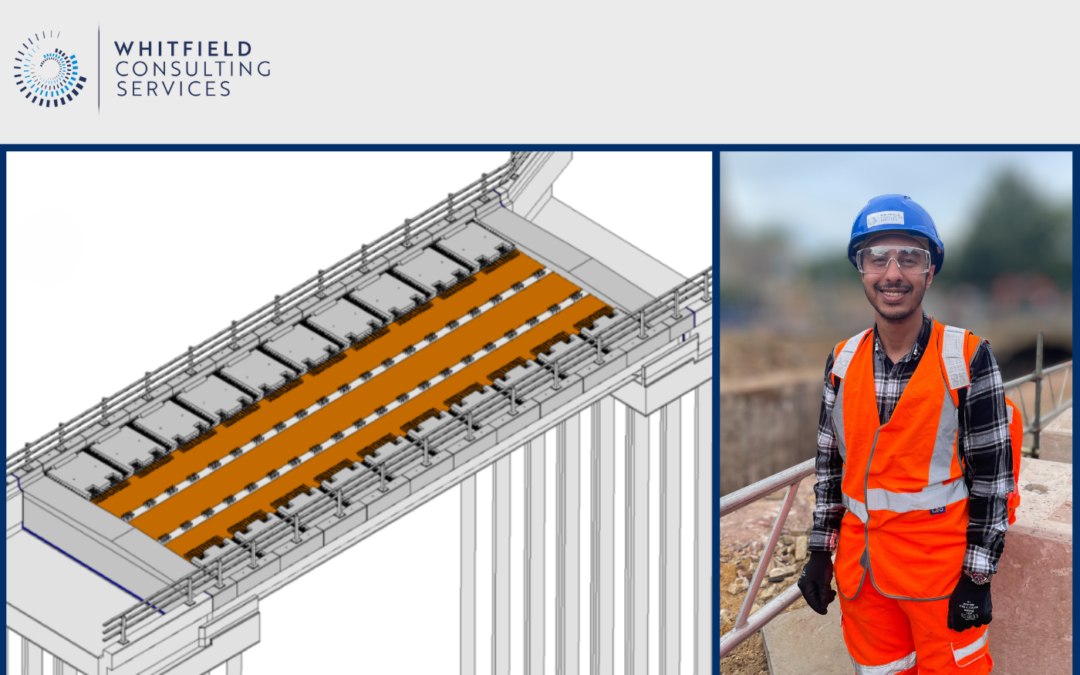
Bridges and access routes that support high‑voltage substations are particularly vulnerable: loss of access often means loss of emergency response capability, inability to transport transformers, and risk to grid stability. Using a recent National Grid substation access bridge delivered for our client Murphy as a case study, this article outlines the engineering principles and practical measures that ensure robust performance in flood‑prone environments.
Understanding the flood environment
“Designing flood‑resilient bridges requires a holistic approach – one that combines hydrology, civil engineering, drainage, materials durability, and whole‑life performance,” says Mohamed Omar, Senior Structural Engineer at Whitfield Consulting Services (WCS).
A flood‑resilient design begins with a precise understanding of the hydrological environment. Detailed modelling is used to establish design flood levels for 1:100 and 1:1000‑year events, together with a climate‑change allowance, which significantly increases predicted water levels. The resulting hydraulic envelope defines the minimum permissible soffit level for the bridge.
In many substation projects, the soffit height must also comply with maximum limits imposed by overhead line clearances, creating a tightly constrained vertical window.
“Balancing freeboard requirements with electrical safety constraints demands careful geometric optimisation early in the design process,” adds Mohamed.
Preserving floodplain connectivity
“Maintaining natural floodplain behaviour is fundamental to resilient design,” says Mohamed. “If a new access road or embankment impedes lateral flow, flood levels may rise on neighbouring land, triggering environmental, regulatory, and insurance consequences.”
To prevent this on the 1.40 km access road, an extensive culvert network was installed — more than 80 units distributed along the alignment — to ensure uninterrupted cross‑floodplain movement of water.
“These culverts are arranged in grouped sets to improve constructability, reduce settlement differential, and maintain consistent conveyance capacity,” explains Mohamed.
Where embankments displace flood storage, engineered flood channels are excavated into the surrounding terrain to restore lost volume and ensure compliance with Environment Agency requirements.
“Such channels can extend over 200 metres, with sufficient width and depth to handle peak flows during extreme events,” he notes.
Material durability in flood‑exposed environments
Flood‑resilient performance relies heavily on durability‑led material selection.
“Weathering steel is frequently adopted for bridge girders due to its ability to form a stable, protective patina when exposed to alternating wet and dry cycles,” says Mohamed.
Environmental assessments, including those from recent substation projects, have confirmed its suitability in locations with low chloride exposure and adequate ventilation beneath the deck. This approach avoids the need for repainting — an especially important advantage at sites where overhead lines restrict access for maintenance.
Complementing this, reinforced concrete decks are designed with enhanced cover and crack‑control provisions to withstand prolonged saturation and freeze–thaw cycles, while stainless steel fixtures are used in splash zones to further enhance corrosion resistance.
“Together, these measures enable bridges to meet the 120‑year design life commonly required for critical national infrastructure,” he adds.
Protecting bearings and abutments from water
In flood‑prone environments, details around the abutments and bearings significantly influence long‑term performance. Elastomeric bearings, which accommodate rotations and movements between the superstructure and substructure, are vulnerable if exposed to standing water or saturated debris.
“To mitigate this, we incorporate protective measures like cheek walls and upstands at pile cap ends to deflect runoff and shield bearings from direct exposure,” explains Mohamed.
Abutments themselves can also be detailed with subtle crossfalls that prevent water from ponding behind the structure, supported by weep holes that relieve hydrostatic pressure during prolonged rainfall or flood events.
“Such detailing ensures the bridge remains stable, dry, and maintainable long after initial construction,” Mohamed notes.
Managing deck runoff and surface water
Effective deck drainage is essential to avoid rapid deterioration in a flood‑exposed structure.
Bridge decks are formed with a crossfall — commonly 1:40 — to drive water towards the kerbline, where longitudinal gradients are coordinated with the wider road design to maintain continuous outflow. The captured runoff is directed into kerb drainage systems, such as channel drains, preventing water from reaching critical structural elements.
“This controlled drainage strategy reduces freeze–thaw risk, minimises chloride ingress, and enhances both safety and durability during extreme weather events,” says Mohamed.
Ensuring operability of access routes during floods
A bridge cannot be considered resilient if its approach roads are rendered unusable during flood events. For substations, where emergency access and the delivery of up to 220‑tonne transformers are essential, access roads must remain passable during even the most extreme conditions.
“To achieve this, road levels are designed above the 1:1000‑year flood level, including climate change uplift,” says Mohamed. Where the ground allows, runoff is managed via swales, filter drains, and shallow soakaways. In locations with high groundwater or limited infiltration potential, the design shifts towards sheet‑flow management and controlled discharge into engineered flood channels.
“This holistic approach ensures that operational access is maintained even during prolonged storm periods, protecting grid reliability,” he explains.
Navigating environmental and overhead‑line constraints
Designing and constructing a flood‑resilient bridge for a substation environment often involves unique constraints.
Live overhead lines restrict the use of lift cranes, meaning bridge beams may need to be delivered pre‑braced and manoeuvred into position using self‑propelled modular transporters to avoid infringement. Similarly, environmental permitting limits excavation depth near watercourses and restricts dewatering volumes to minimise ecological impact.
“These constraints must be built into the design from the outset to avoid later clashes and ensure compliance with Environment Agency requirements,” explains Mohamed.
The importance of early multidisciplinary collaboration
“Flood‑resilient bridge design is inherently multidisciplinary. Structural, hydrological, geotechnical, environmental, electrical, and highway specialists must coordinate from the earliest design stages to avoid conflicts between requirements,” says Mohamed.
For example, hydraulic freeboard must align with OHL electrical clearance; drainage layouts must integrate with floodplain connectivity measures; and environmental restrictions must be reconciled with constructability.
“Such collaboration significantly reduces the risk of redesign, delays, or unexpected flood‑related issues during delivery,” adds Mohamed.
Navigating FRAP requirements and flood‑zone regulatory constraints
Flood‑resilient bridge design is not driven by engineering judgement alone; it is also tightly governed by regulatory controls such as the Flood Risk Activity Permit (FRAP), issued by the Environment Agency. These permits regulate any activity taking place within or near a watercourse or floodplain, including excavation, dewatering, temporary works, haul roads, and the placement of embankments.
“Their constraints directly influence both the design and construction methodology of substation access bridges,” explains Mohamed.
FRAP impact on construction strategy and techniques
On recent substation projects, FRAP requirements significantly shaped the early works strategy.
For example, the Temporary Haul Road could not be raised above the natural floodplain level because a FRAP had not yet been secured for permanent works. As a result, only the first 200 metres of the road could be constructed to full permanent standards, while the remainder had to remain at existing ground level to avoid altering floodplain behaviour.
“This constraint ensured compliance but required the design to incorporate alternative measures for maintaining access during early construction,” he explains.
FRAP restrictions also limit excavation depth, the extent of dewatering, and the disturbance of riverbanks and habitats. These considerations directly affect bridge substructure construction and influence decisions such as the use of low‑impact piling methods, the placement of temporary sheet piling, and the avoidance of deep temporary works within the flood zone.
“In practice, this means the engineering team must identify construction techniques that maintain stability and safety while staying within the narrow operational window permitted by the FRAP,” he adds.
Regulatory constraints in design
Incorporating FRAP constraints into the design from the outset helps prevent delays and mitigates the risk of having to redesign embankments, drainage systems, or river‑adjacent works late in the programme.
Early engagement with the Environment Agency is essential — not only to secure approvals but also to confirm that proposed floodplain interventions, culvert arrangements, access road levels, and bridge drainage strategies align with regulatory expectations.
Through thoughtful compliance with FRAP requirements, the project maintains environmental protection, preserves floodplain functionality, and ensures construction operations do not inadvertently raise flood risk elsewhere.
“In this way, FRAP becomes not just a regulatory hurdle but an integral part of a resilient, sustainable bridge design strategy,” concludes Mohamed.
Infrastructure built for the future
“Flood‑resilient bridge design for critical national infrastructure demands a technically integrated approach that goes far beyond simple flood‑level calculations,” says Mohamed.
Resilience is achieved through a combination of:
- Robust hydraulic analysis
- Durable material strategies
- Careful detailing around bearings and abutments
- Controlled surface water management
- The preservation of natural floodplain behaviour.
“When combined with a disciplined multidisciplinary process and a deep understanding of environmental and operational constraints, these principles enable the creation of bridges and access routes that remain safe, reliable, and maintainable throughout their 120‑year design life — even as climate‑driven flood risks continue to evolve,” he adds.
Contact WCS
With flood risks rising across the UK, bridges must be designed to withstand increasingly severe weather events. WCS’s approach demonstrates that these challenges can be met through thoughtful civil design, careful material selection, and collaborative engineering.
If you would like to discuss your next project, please get in touch by emailing info@wcs-consult.co.uk or calling +44 (0)20 3581 7847.