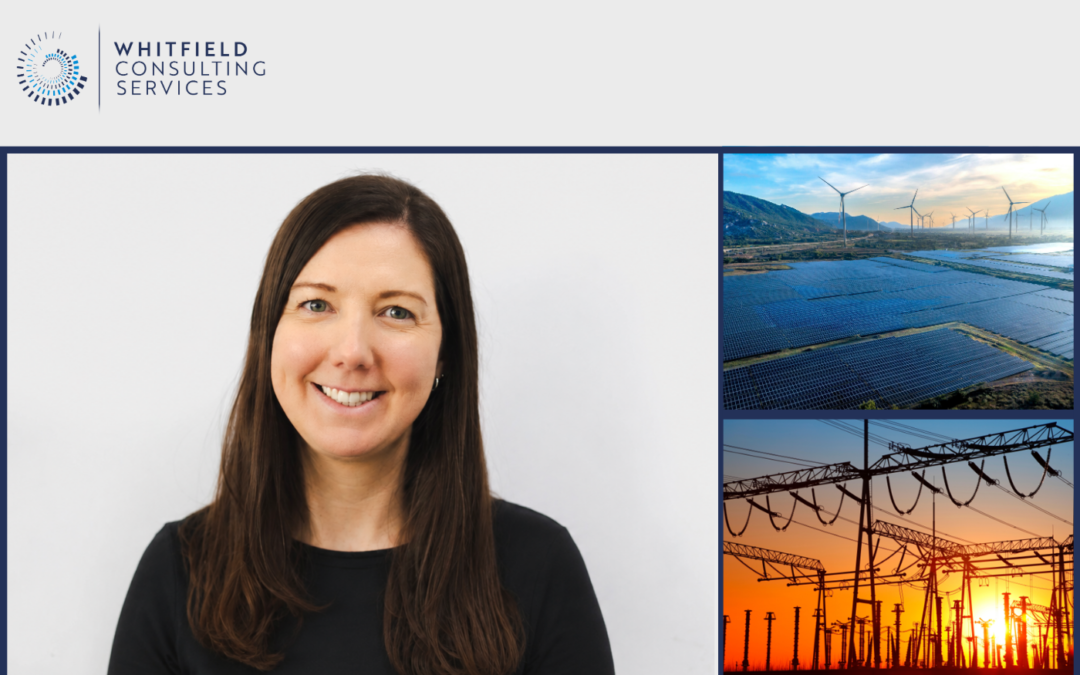
Driven by a long-standing desire to create a more sustainable future, Kirsty Glover has built her career around energy transition work – using engineering, project leadership and carbon management to help deliver infrastructure that supports renewable energy and electrification.
Kirsty joined Whitfield Consulting Services (WCS) in September 2025 as Associate Director, bringing over 13 years of experience in the Power & Energy sector. At WCS, she is focused on delivering the design for major Power & Energy projects, developing the next phase of the company’s sustainability strategy, and supporting initiatives that introduce more young people to engineering.
In this interview, Kirsty discusses her route into the profession, why renewables became a key focus, and how she is helping embed sustainability into project delivery.
Building a career across civil engineering and energy
Kirsty’s interest in engineering started early, influenced by her grandfather, who worked as a civil engineer. Growing up, she spent all school holidays in the Highlands with her grandparents and cousins, where practical projects were part of everyday life.
“We were always building things or fixing things,” she says. “I liked maths, practical problem-solving and working out how things fit together, so engineering felt like a natural route. I was also very into Lego, which was probably an early sign!”
After studying civil engineering at the University of Strathclyde, Kirsty began her career at Petrofac. At the time, following the 2008 financial crisis, opportunities in infrastructure felt limited, while oil and gas was actively recruiting graduate engineers.
Although she started in oil and gas, Kirsty was already focused on how engineering could support environmental progress.
“I care about the environment,” she says. “Climate change was happening, and I could see that more action was needed. I felt that by working within the energy industry, you could help change how companies were operating.”
That motivation led Kirsty towards renewables and energy transition work from within the sector. She became involved in offshore wind and later helped develop wider renewables capability across carbon capture, hydrogen, wind and emissions reduction.
“It felt like you were helping solve part of the problem,” she says.
During her 13 years in the role, Kirsty had the opportunity to work internationally, including complex vessel refurbishment projects in Poland, offshore asset integrity work in Mexico and business development in Houston. She also holds an MBA in Sustainability and Energy Transition.
“The MBA helped me understand how to build the case for sustainability,” she says. “It explored how emerging technologies can be made more viable and appealing, as well as the role of government policy, environmental, social and governance reporting (ESG), and carbon accounting in supporting the energy transition.”
Joining WCS
Kirsty joined WCS to support its major energy infrastructure work, including a project to support one of the UK’s largest airports and its long-term electrification plans.
Her role involves leading civil and structural design activity for new substations and associated infrastructure, helping increase electrical capacity across the airport estate.
“The work is focused on bringing in additional electrical capacity to support the wider transition away from fossil fuel-based systems,” she says.
The projects are progressing through preliminary and detailed design stages, with carbon assessment forming part of the design process.
“We’re carrying out carbon assessments alongside the engineering design work,” Kirsty explains. “That includes reviewing where prefabricated elements, material choices or different construction approaches can help reduce embodied carbon.”
For Kirsty, one of the most rewarding parts of engineering is seeing projects move from design into construction.
“I always enjoy working on projects where you can follow the process all the way through and eventually see what’s been built.”
Developing WCS’s sustainability strategy
Alongside her project responsibilities, Kirsty is part of WCS’s sustainability forum and has been leading the development of the company’s wider sustainability strategy.
The strategy covers operational carbon management, sustainability reporting, carbon reduction planning and how carbon assessment can be integrated more consistently into project delivery.
“We’ve been developing both the operational side and the civil design side of the strategy,” she says. “That includes how sustainability can become a more consistent part of project delivery and engineering decision-making.”
WCS is also introducing new carbon management tools to improve emissions tracking and reporting across the business.
The sustainability forum is supporting internal training on carbon reduction, low-carbon materials and sustainable engineering practice.
“We’re looking at how we build more awareness internally and support engineers with the tools and understanding to factor sustainability into design work earlier in the process.”
Working at WCS
For Kirsty, joining WCS has meant becoming part of a collaborative and diverse working environment, with a strong sense of connection across the business.
“I love it,” she says. “It’s been such a refreshing difference. I always found I worked best in close-knit teams, and WCS has that environment.”
She also highlights the diversity across the business and the company’s investment in younger engineers as key positives.
“There’s a really good mix of people, backgrounds and experience levels,” she says. “You can see there’s a genuine focus on bringing people through, supporting graduates and creating opportunities.”
Supporting future engineers
Kirsty is involved in outreach and engagement initiatives aimed at encouraging more young people into engineering careers.
Since joining WCS, she has supported careers events, school engagement activities, and an engineering contest at the University of Surrey.
“Many pupils still don’t really understand what engineering involves,” she says. “The more exposure they get to the industry at an earlier age, the better.”
Having spent much of her earlier career as the only woman in project meetings or on engineering sites, Kirsty has also seen positive changes in diversity across the industry, and highlights WCS’s approach as exemplary.
“The commitment is visible across WCS,” she says. “You can see it comes from the top, and every team member supports inclusivity.”
Looking ahead
As WCS continues expanding its work across Power & Energy, Kirsty is particularly interested in supporting projects linked to onshore wind, electrification and emissions reduction.
“A huge amount is happening across the energy sector,” she says. “Different technologies move at different speeds depending on investment and policy support, but there’s continued demand for infrastructure that supports lower carbon energy systems.”
Alongside project delivery, Kirsty is focused on helping move the next phase of WCS’s sustainability strategy from planning into implementation across the business.
“We’re setting a more complete baseline now to include a better picture of our Scope 3 emissions — the indirect emissions generated across our wider value chain, such as purchased goods and services, business travel and employee commuting,” she says. “The next step is making sure we can track progress, improve how we report, and keep building sustainability into the way we design and deliver projects.”
If you’re looking for a dependable partner for your next infrastructure project, contact WCS to see how we can support you. Get in touch.