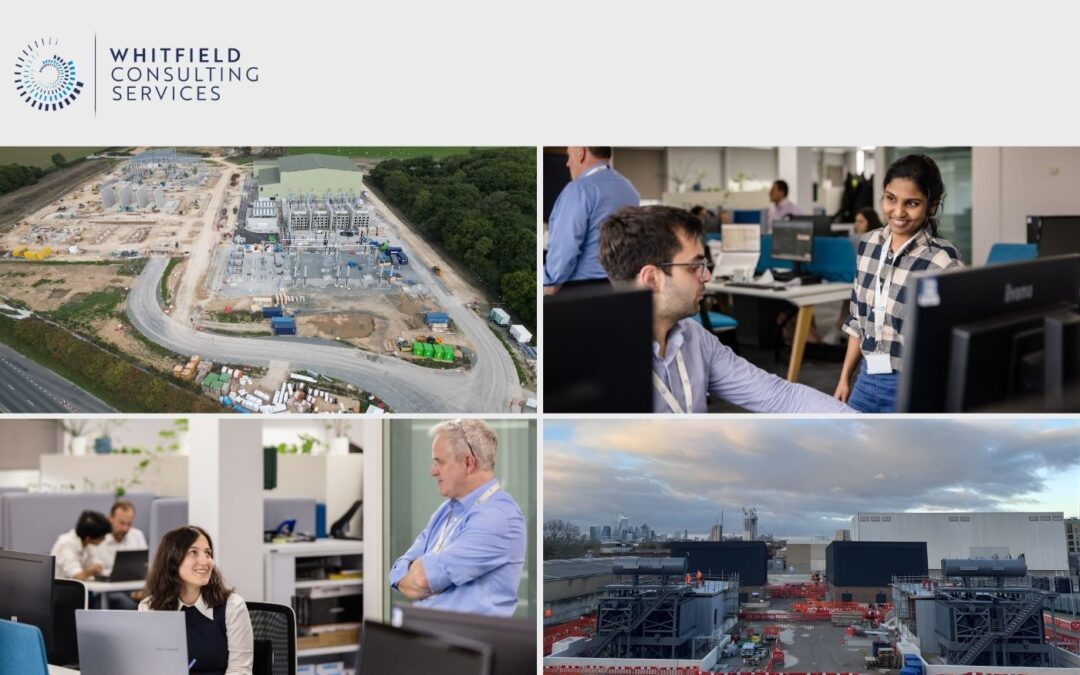
The recurring civil engineering challenges on distribution and transmission infrastructure projects are familiar: incomplete early-stage information, constrained operational sites, cable routing, buried services, equipment access, temporary works, assurance requirements and outage-driven programmes.
What matters is how those challenges are managed.
Whitfield Consulting Services (WCS) brings civil and structural engineering experience into the process early, helping clients test assumptions, resolve interfaces, coordinate with electrical teams and develop designs that can be approved, built and maintained within demanding project constraints.
“Several of our senior team members have worked for and alongside large electrical contractors and tier one organisations,” says Asa Whitfield, Managing Director at WCS. “We understand what they are trying to achieve and where the challenges tend to arise.”
“It is about being agile, working closely with stakeholders and other disciplines, and challenging conventional approaches so we can arrive at a practical, viable solution,” adds Celine Mahfoud, Civil/Structural Design Engineer at WCS.
1. Early civil input during feasibility and concept design
Civil and structural input is most effective when it is integrated at feasibility and concept stage, while layouts, routes, drainage, access and sequencing are still being coordinated across disciplines.
“For civil and structural consultants, the earlier we are involved, the earlier we can look at site-specific and project-specific constraints,” says Dr Natalja Petkune, Director at WCS. “As designers, it is our responsibility to define the issues, identify control measures and, where possible, eliminate the risk.”
Nick Lowe, Director at WCS, says early involvement is particularly valuable while electrical layouts are still developing. “Early information exchange allows both disciplines to shape the design together. By sharing survey findings, equipment requirements and site constraints as they emerge, we can coordinate the layouts more effectively, plan around potential challenges and identify opportunities to improve the overall design.”
2. Incomplete or evolving site information
Topographic surveys, buried services records, utility surveys, ground investigation data, drainage information and flood risk assessments all influence the civil design solution. Without them, designs may progress around assumptions that later prove costly or impractical.
On existing substations, unknown buried services can affect foundation locations, transformer bund geometry, cable routes, drainage strategy and temporary works.
“Unknown information within a site is a challenge,” says Natalja. “But it is about being adaptable, understanding how critical it is for the contractor to receive information quickly, and coming up with a solution that works with the constraints.”
3. Cable routing and infrastructure crossings
Cable routing needs to be considered alongside equipment layout, foundations and constructability from the outset.
“Once equipment positions and foundation designs are fixed, the available cable routing options narrow quickly. Considering the route earlier gives the team more flexibility to avoid clashes, complex crossings and unnecessary redesign,” says Nick.
WCS supports clients through early route feasibility, optioneering and coordination with electrical teams, surveyors and geotechnical specialists. This includes identifying obstacles, assessing utility congestion, reviewing crossing options and considering joint bay locations, pulling distances, temporary works and approvals.
The shortest route is not always the most deliverable. In some cases, a longer alignment can reduce utility conflicts, avoid complex crossings and support a more practical installation strategy.
For more on how WCS approaches complex cable route design, read: Overcoming challenges in urban and renewable energy projects.
4. Equipment access, installation and future replacement
Transformer delivery and installation are recurring challenges across constrained substation sites. Many substations sit behind residential areas, down narrow access roads, or within compounds not originally designed around modern replacement requirements.
“Quite a lot of DNO substations are tucked away behind residential areas,” says Nick. “You might have a very narrow access road to get to the substation, and then you need to bring in a 30 or 40 tonne transformer and get a crane in to lift it. Sometimes that simply is not possible, so you need to consider alternatives, such as skidding the transformer into position.”
This affects crane positions, working platforms, temporary works, abnormal load movements, access routes and future maintainability. A foundation or bund may be technically compliant, but the equipment still needs to be delivered, installed, maintained and replaced safely.
5. Constructability within constrained operational sites
On live substations, civil engineering design has to be developed around electrical constraints. Electrical clearances, outages, buried high-voltage cables, earthing requirements and restricted working areas all influence what can be built, when it can be built and how the work should be sequenced.
“You cannot safely work right next to 132,000 volts,” says Asa. “You need to stage the works and work with the electrical team to help drive the construction sequence, or select the option that is workable within a live substation environment.”
Celine says early construction input is equally important. “By combining our design expertise with the construction team’s knowledge of site delivery, we can refine the construction sequence, address practical constraints and develop solutions that are both technically robust and buildable”.
6. Standards, assurance and challenging the brief
Distribution and transmission infrastructure projects are delivered within defined technical and assurance requirements, but experienced civil engineers can still add value by challenging assumptions within those parameters.
“We don’t simply take on a design and carry it through,” says Celine. “We challenge it. Could it be done differently? Could it be more sustainable? Could an existing foundation or piece of equipment be reused if the surveys, inspections and checks support it?”
This approach was reflected on National Grid’s London Power Tunnels 2 project, where WCS was appointed by Linxon as lead civil designer for the New Cross and Bengeworth Road substations.
“We applied independent engineering judgement to challenge oversized foundations and optimise designs, reducing material use and programme risk,” says Victor Lupusor, Senior Civil Engineer at WCS. “This collaborative approach identified efficiencies without compromising safety or performance.”
Asa adds: “It is not as simple as reading an engineering standard. There are choices to be made within those standards, and different ways of achieving the requirements.”
7. Outage-driven programmes and design coordination
Outage windows can define the delivery strategy on power infrastructure projects. Missing an outage can have significant implications for cost, sequencing and wider network planning.
Design packages therefore need to be coordinated, checked, documented and submitted in a way that supports approval and construction readiness.
This is where working with a consultant with assurance capability, including Contractor Design Approval Engineer (CDAE) experience on National Grid projects, can add real value. By understanding the required standards, submission processes, design interfaces and approval expectations, the CDAE role helps identify issues before they become formal comments or programme risks.
For WCS, design assurance, document control, drawing management and technical coordination sit within the engineering task. They directly influence whether designs can move through approval, construction and commissioning without avoidable delay.
Looking for support on your next transmission and distribution infrastructure project?
Our Power & Energy team supports projects across the UK and Ireland, with experience including National Grid’s London Power Tunnels 2 programme, Ørsted’s Hornsea 3 offshore wind connection, and UK Power Networks and SSEN RIIO-ED2 network upgrades.
Learn more about our experience in our project showcase, or contact the WCS Power & Energy team to discuss your next project or framework requirement.
Email: power@wcs-consult.co.uk
Website: www.wcs-consult.co.uk