Whitfield Consulting Services (WCS) is providing detailed civil engineering design to UK Power Networks Services (UKPNS) under Ofgem’s RIIO-ED2 framework, a regulatory framework which runs from 2023 to 2028, focused on enabling the transition to Net Zero, strengthening network resilience, and funding essential upgrades to the UK’s electricity distribution networks.
As part of this framework, WCS provided civil and structural engineering services for the replacement of two existing transformers and associated electrical equipment at a UK Power Networks (UKPN) substation in North London. The upgrade was delivered to improve network resilience and support long-term asset renewal in line with the objectives of the RIIO-ED2 programme.
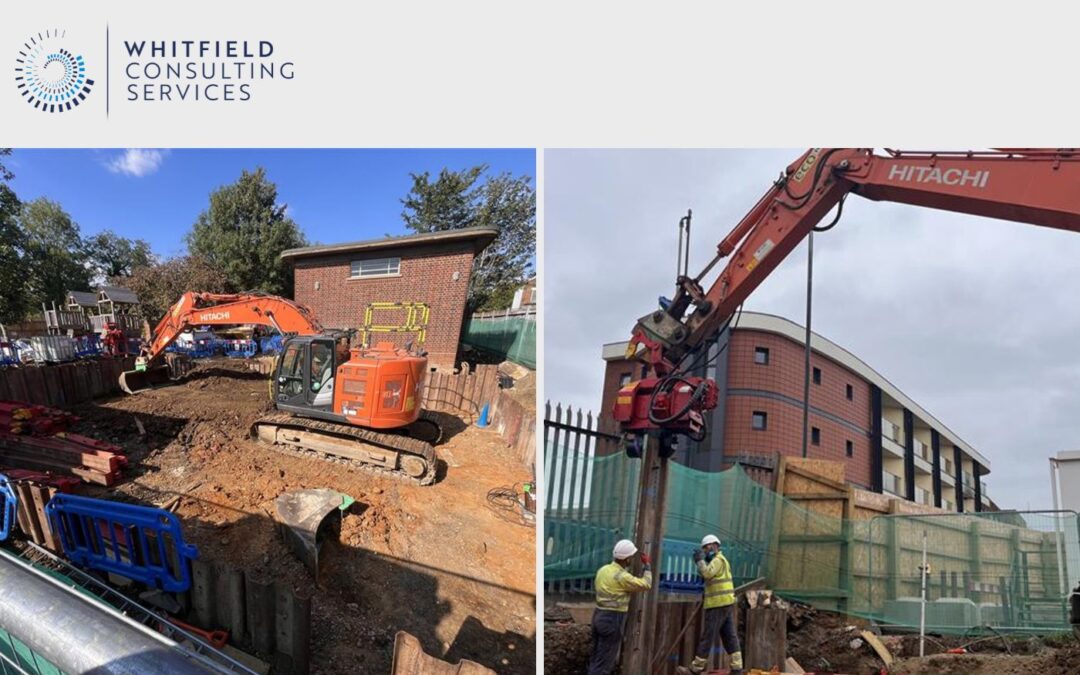
From concept through to detailed design, temporary works and construction support, WCS delivered civil and structural engineering expertise across the project including transformer bunds, fire walls, equipment foundations, cable routing, masonry wall assessments and design, road reinstatement, site-enabling works, and excavation support.
The challenge
The s project presented a combination of technical, logistical and stakeholder challenges that needed to be addressed from the earliest stages of design. These included:
- Significant spatial constraints on a small urban site
- A Grade II listed boundary wall
- Working within a live substation environment
- Limited archive information available at concept stage
- Equipment delivery and construction sequencing requirements
- Vibration risks to adjacent structures during excavation and installation works
Responding to site constraints
The site’s spatial constraints influenced equipment positioning, access requirements and the overall feasibility of the proposed design solutions.
“This site is particularly small, with a lot of constraints,” says Celine Mahfoud, Civil/Structural Design Engineer at WCS. “The location is in a residential area, with houses around it, a hotel just across the road and a school behind the site.”
At concept stage, WCS explored multiple layout options and worked with transport consultants to assess how large transformer units could be delivered to site. Detailed access assessments and swept-path analysis enabled the team to identify delivery constraints early and eliminate options that were not practical to construct.
The project was further complicated by limited archive information. “Multiple site visits, measurements and inspections were required to verify existing conditions, with some site features differing from available archive information,” says Celine. “This helped ensure the design reflected the reality of the site rather than relying solely on historic records.”
The restricted footprint also meant that construction sequencing had to be carefully considered from the outset to ensure works could be delivered safely and efficiently.
The solution
WCS adopted a proactive design approach, using early-stage optioneering to review layouts, access, constructability and sustainability considerations before progressing into detailed design.
Regular interdisciplinary review meetings with UKPNS, UK Power Networks and the wider design team enabled potential clashes, stakeholder concerns and design interfaces to be identified and addressed early in the project, reducing the risk of changes later during delivery.
The WCS team challenged conventional design approaches to improve sustainability and constructability. Alternative transformer bund configurations were explored to reduce excavation depth, concrete volumes and overall site disruption.
“We looked at whether we could reduce the amount of stone and have a shallower excavation because of how restricted we were on site,” says Celine. “Having less concrete meant we could save on carbon emissions and have a more sustainable design.”
For smaller secondary transformers, WCS also adopted a precast foundation solution to reduce construction time and site activities.
Managing heritage and site constraints
A particularly distinctive aspect of the project was the Grade II listed boundary wall. To create sufficient space for construction activities, sections of the wall required demolition and reconstruction.
WCS undertook the site inspections, condition assessments and structural design needed for the works and confirmed that the existing foundations could continue to support the reconstructed wall.
Temporary works and construction support
The team was tasked with designing a soil retaining system to maintain the stability of adjacent structures throughout construction. A key consideration was the nearby switching room, where vibration levels had to remain strictly within agreed limits. This requirement influenced both the installation methodology and the choice of retention system.
WCS developed two temporary works options to provide the contractor with flexibility during delivery. You can read more about these solutions and the chosen approach in our article, Spotlight on temporary works for bridges & structures.
The WCS approach
For Celine, the project highlights the importance of agility, collaboration and practical problem-solving when delivering infrastructure upgrades in constrained operational environments.
“Things can change very quickly, but being able to adapt and work in short timeframes was essential,” says Celine. “It was about working closely with a multidisciplinary team, challenging the conventional approach and thinking outside the box to develop a practical, viable solution.”
Read more about Celine’s earlier career journey, her experience joining WCS first as a Graduate Civil Engineer, and her work helping to deliver infrastructure for a more sustainable future: Building a Net Zero world and inspiring future generations: Meet Celine Mahfoud.
Looking for support on your next grid infrastructure project?
Whether you are a transmission network operator, distribution network operator, independent connection provider, framework delivery partner or contractor delivering substation upgrades, network reinforcement schemes or renewable energy connections, WCS can provide the civil and structural engineering capabilities needed to support efficient and compliant delivery.
To discuss your next project or framework requirements, contact our Power & Energy team at power@wcs-consult.co.uk or visit www.wcs-consult.co.uk.