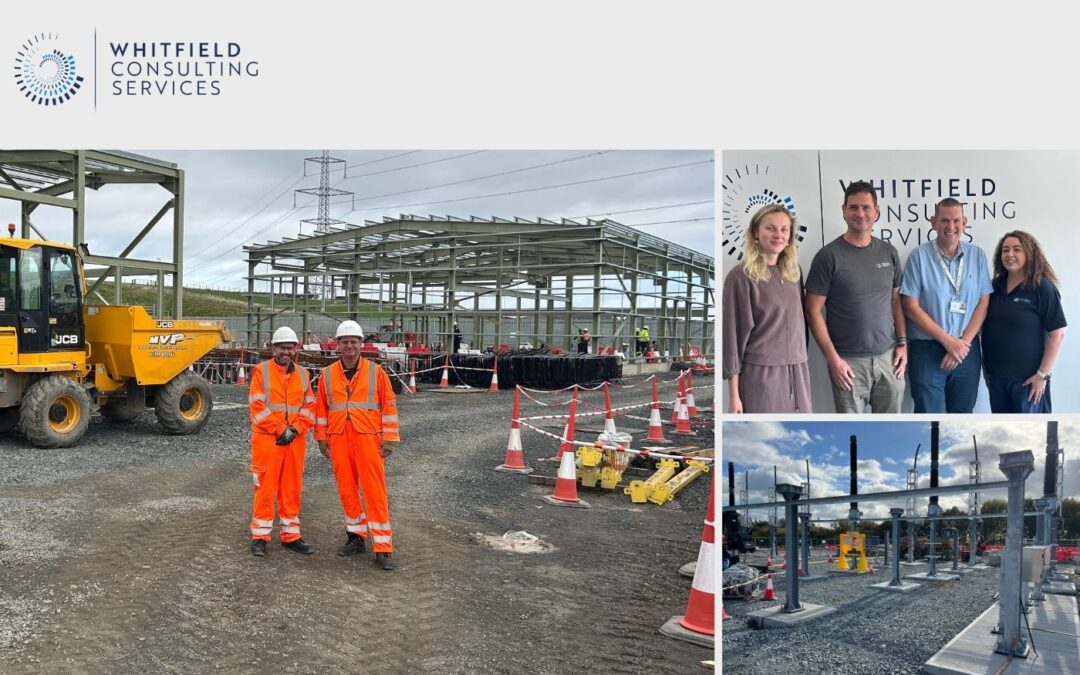
Whitfield Consulting Services (WCS) has Contractor Design Approval Engineer (CDAE) capability across its team, including Managing Director Asa Whitfield and Directors Dr Natalja Petkune and Nick Lowe.
A CDAE is a senior, authorised engineer responsible for approving designs on high-voltage infrastructure projects. The role involves ensuring designs comply with National Grid’s rigorous safety requirements, specifications, technical policies and design standards before they are submitted for approval.
Here, they explain how WCS supports clients through the CDAE role, helping to maintain submission quality, programme certainty and coordination around fixed outage windows, equipment deliveries and tightly sequenced construction activities on National Grid projects.
Dr Natalja Petkune: Leading design approval on the UK’s largest substation project
Natalja’s CDAE experience includes a role on the UK’s largest substation project, a nationally significant infrastructure development in West London forming part of National Grid’s programme to strengthen the UK’s high-voltage transmission network. Natalja acts as both Lead Contractor Design Approval Engineer (LCDAE) and CDAE for Civil Design. Her experience reflects the coordination required across design packages, disciplines and project organisations.
WCS’s wider civil and structural scope on the project includes major access infrastructure designed to accommodate 220-tonne transformer deliveries, highway and drainage design, flood relief structures and a new 26-metre bridge. The project also involves complex ground conditions, existing utilities and overhead transmission lines, demonstrating the scale and complexity of the design interfaces Natalja is helping to manage.
“The main obligation is making sure National Grid’s requirements are being met,” says Natalja. “The role brings different disciplines and design packages together, so the interfaces between them are properly understood and managed.”
Those interfaces may include civil, structural, electrical, mechanical and environmental requirements, together with health and safety, operational access, maintenance and sustainability considerations. WCS can support clients by chairing assurance meetings, coordinating submissions, monitoring design progress and ensuring responsibilities remain clear across the project team. This is particularly important where individual packages are technically compliant in isolation but create conflicts when combined.
Natalja also highlights the breadth of competence required. CDAE appointments depend on relevant high-voltage and infrastructure experience, professional qualifications, knowledge of National Grid supplier requirements and evidence of multidisciplinary design coordination.
“You have to demonstrate a track record of delivering and coordinating multidisciplinary designs, together with project experience that is relevant to National Grid,” she says. “The application is supported by a competence matrix and endorsed by the contractor before it is submitted for approval.”
WCS can also provide independent design checking, including Chartered Engineer sign-off. This sits within a wider commitment to professional development, with chartered engineers supporting and mentoring colleagues progressing through the relevant training and competence routes.
Asa Whitfield: Supporting programme certainty
The CDAE role is closely connected to helping clients maintain progress towards fixed outage and construction dates. This is particularly important on National Grid projects, where site mobilisation, equipment delivery, and contractor resources will all be planned around a defined network outage.
“An outage is a drop-dead date,” Asa explains. “You need to hit site when planned because, if you miss that window, you can effectively miss it for another year.”
Outages must be coordinated around wider network demand and operational requirements. Delays during design can therefore have far-reaching consequences extending well beyond the design programme.
“These are major projects,” Asa says. “You may already have a site team in place, with significant monthly preliminary costs, waiting for the work to progress. Missing an outage can have a substantial commercial impact.”
The CDAE helps reduce this risk by ensuring that submissions comply not only with the technical design requirements but also with National Grid’s drawing, document and design management processes.
“You can spend four or eight weeks preparing a design pack and submit it expecting approval or a manageable set of technical comments,” Asa explains. “If it comes back because the drawing titles or numbering do not meet the requirements, you could lose a month on the programme.”
WCS’s role as CDAE is to help identify and resolve these issues before submission, reducing the risk that otherwise compliant design packages are delayed by avoidable document or process errors.
“Getting the drawing management process right, understanding the management of the works and following the design management process are all important,” he says. “They can directly affect whether the project maintains momentum.”
Asa and the wider team maintain their competence through refresher training undertaken every two years. This covers National Grid supplier requirements, drawing and document management, design management, environmental responsibilities and the risks associated with impressed voltages.
“There is a lot involved in the drawings and management process for National Grid,” Asa says. “The refresher training reinforces the National Grid supplier, drawing and design management requirements that CDAEs must understand and apply.”
Nick Lowe: Bringing constructability into assurance
Nick brings a strong construction and site-delivery perspective to WCS’s CDAE capability.
Having spent a significant part of his career in site-based roles, his approach considers whether a compliant design can also be delivered safely and efficiently within the project constraints.
“Compliance with the specification is essential, but the design also has to be practical to build within the site constraints,” says Nick.
On operational substations, this may involve electrical clearances, temporary works, abnormal-load access, craneage, transformer installation, cable routing and staged construction around live infrastructure.
“We recognised that there was a growing need for CDAE support on the larger National Grid projects we were bidding for,” Nick explains. “For WCS, it was a natural development of our existing design, coordination and assurance experience.”
One team across the Power & Energy project lifecycle
The value of WCS’s CDAE capability also lies in how it complements the company’s wider Power & Energy services.
For clients, CDAE support can be accessed alongside the other capabilities required across National Grid and high-voltage infrastructure projects. WCS supports projects from feasibility and tender stages through civil and structural design, multidisciplinary coordination, temporary works, independent checking and construction support, with a portfolio spanning substations, transformer infrastructure, switchgear buildings, cable routes, BESS developments and National Grid connections.
Download our Power & Energy Capability Statement to explore our experience, services and project capabilities across the sector.
To discuss your next project or framework requirements, contact our Power & Energy team at power@wcs-consult.co.uk or visit www.wcs-consult.co.uk.