Battery energy storage projects require civil and structural design that can resolve multiple technical and programme constraints in parallel.
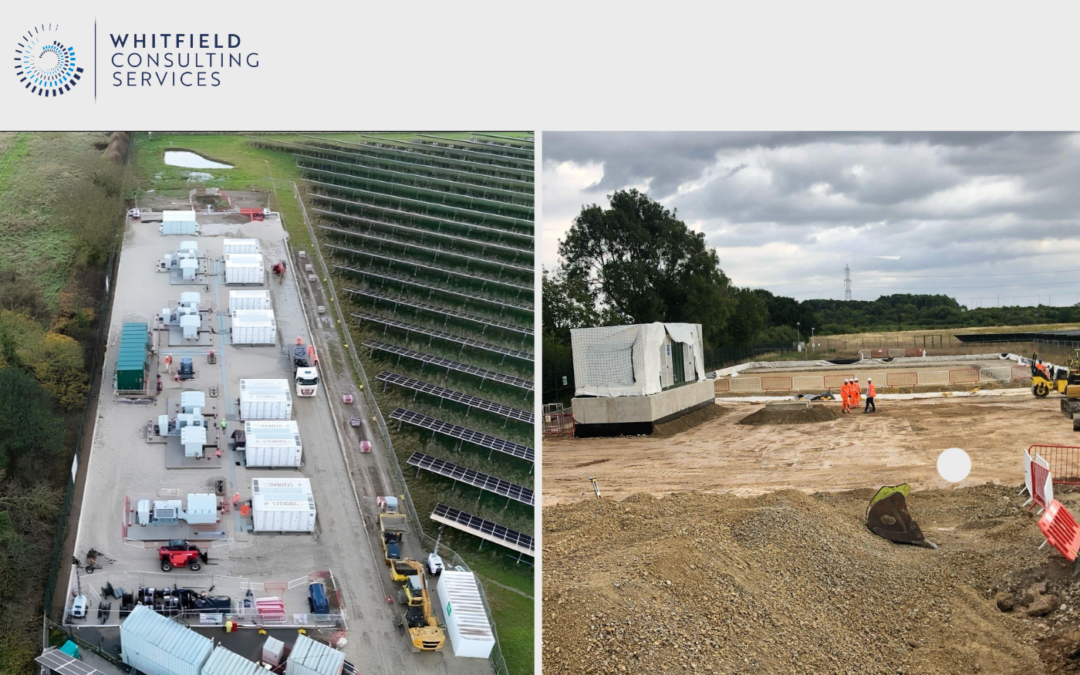
At Mauxhall Farm – a 25MW Battery Energy Storage System (BESS) development – the principal considerations included tidal flood risk, dual-purpose stormwater and firewater containment, a compressed delivery programme and coordination with separately developed electrical packages. Alongside resolving these technical requirements, WCS applied value engineering through the design process to improve cost-effectiveness, support buildability and help maintain programme certainty.
In this case study, we look at how the WCS team, led by Shane Govender, Principal Civil Engineer, addressed those challenges through detailed civil and structural design, developing solutions that supported construction, compliance and long-term site performance.
Project overview
The site is located on greenfield land at Mauxhall Farm near Stallingborough, Grimsby. The scheme comprises battery containers, Power Conversion Systems (PCS), a substation and the wider electrical balance of plant, and is now in the final stages of construction.
Whitfield Consulting Services (WCS) was appointed by OCU Group to deliver detailed civil and structural engineering design, together with temporary works design. The scope included site layout, earthworks, stormwater and firewater drainage containment, foundations for key equipment and structures, retaining walls, cable containment, internal roads, fencing, and temporary works.
The project builds on WCS’ broader experience in the BESS sector, including Monk Fryston, one of the UK’s largest battery energy storage schemes, where similar issues around containment, constructability and design coordination were addressed within a tight delivery programme.
Meeting the demands of BESS design
Battery energy storage projects bring together a mix of civil, structural and electrical requirements, often within tight programmes and constrained site conditions.
“Each site brings its own constraints, but the principles are consistent – you’re working to integrate drainage, levels, geotechnical and environmental constraints, structural design and electrical infrastructure. With BESS projects, many of the key decisions sit in the civil design early on. If those are resolved clearly at the outset, it provides a stable, predictable platform for all other disciplines, Original Equipment Manufacturer (OEM) alignment, fewer late-stage surprises, a more coordinated construction issue package, and gives the project a much stronger footing as it moves into construction overall,” says Shane.
Challenge one: designing within Flood Zone 3
The Mauxhall site is located predominantly within Flood Zone 3 and subject to tidal flood risk.
WCS developed a flood mitigation strategy that integrated resilience into the core civil design. Foundations for battery containers, Power Conversion (PCS) units and key electrical equipment were elevated above the assessed flood level, including climate change allowances. Sealed penetrations were incorporated to maintain performance during inundation.
Compensatory floodplain storage ensured the development did not increase off-site flood risk, while a SuDS-based drainage approach enabled controlled surface water discharge.
“Flood‑resistant and resilient construction reduces the likelihood of damage, contamination or hazardous failures. Together, these measures demonstrate that the development can operate safely within Flood Zone 3, maintain environmental protection, and support wider decarbonisation objectives without exacerbating flood risk elsewhere,” says Shane.
Challenge two: firewater and stormwater containment
The project required compliant management of both stormwater and firewater within a constrained footprint, with a clear need to maintain environmental protection.
WCS developed a combined containment strategy, integrating both requirements into a single engineered system. The BESS compound was formed as a bunded platform using permeable granular material over an impermeable liner, enclosed by retaining walls designed for hydrostatic and surcharge loading.
The system incorporated:
- Dual-purpose containment across the site
- Class 1 separators for contamination control
- Automated penstock valve for isolation
- Hydrobrake-controlled discharge limited to 1 l/s
- Low-point collection discharging to an existing pond
“Our dual‑function approach reduced land take, avoided additional ecological disturbance, and provided a resilient, environmentally responsible solution within tight spatial constraints,” says Shane.
Challenge three: delivering design to programme
The construction programme required early mobilisation, placing pressure on design development while maintaining coordination and buildability.
WCS addressed this by defining key constraints early and progressing foundations, earthworks and drainage design in parallel. Standardised, pre-validated details reduced the need for bespoke engineering, while prefabricated and precast elements supported efficient construction.
A tiered release strategy allowed enabling works to begin while detailed coordination continued. Early contractor involvement supported sequencing and buildability, helping maintain programme certainty.
Challenge four: civil and electrical interface coordination
Electrical integration was undertaken by a separate designer, introducing interface considerations around layouts, trenching, duct banks and equipment positioning.
WCS implemented a structured coordination process supported by regular interdisciplinary reviews and clearly defined interface points. Civil layouts incorporated early allowances for electrical infrastructure, including cable corridors and equipment zones.
A design responsibility matrix defined ownership across disciplines, supporting clear integration and reducing the risk of clashes during construction.
“The interface between civil and electrical design is a consistent feature on BESS projects. Early alignment reduces clashes and gives the project greater certainty once work starts on site,” says Shane.
Value engineering
Value engineering was applied as part of the design process to improve cost-effectiveness without compromising technical performance, compliance or buildability.
“The focus was on reducing avoidable complexity, improving coordination and supporting efficient delivery across the site,” says Shane.
Four key areas contributed to that outcome:
- Early civil-electrical coordination reduced redesign risk
Electrical allowances were incorporated into the civil layout from the outset, including trench corridors, equipment zones and containment routes. This reduced the likelihood of clashes, late-stage design changes and associated disruption during construction. - Integrated containment reduced footprint and construction scope
Stormwater and firewater requirements were combined within a single engineered containment system, avoiding multiple standalone solutions and reducing land take, construction effort and ecological disturbance. - Flood resilience was incorporated into the primary design
Raised foundations, sealed penetrations and compensatory floodplain storage were designed in from the outset, reducing the need for later modifications and improving long-term resilience. - Standardisation and phased delivery supported programme certainty
Standardised details, prefabricated and precast elements, and a tiered release of design information reduced bespoke engineering, supported early mobilisation and improved sequencing on site.
Why clients trust WCS
In the complex Power & Energy sector, partnering with consultants who bring foresight, practical expertise, and a collaborative approach helps clients meet their cost, quality, and time objectives with confidence.
WCS’s approach reflects a consistent focus on early engagement, technical clarity and close collaboration with clients and project teams. By defining key constraints early, coordinating across disciplines and maintaining flexibility through the design process, WCS supports projects from concept through to construction with a clear understanding of both engineering requirements and delivery pressures.
“Whether it’s a BESS development or another infrastructure project, we apply the same core approach – agility, collaboration and industry experience. That means combining practical support for construction teams with technical design capability, so we can respond to site-specific challenges while maintaining programme momentum, quality and buildability,” says Shane.
Power & Energy experience
WCS is a civil engineering partner to leading businesses across the UK and Ireland, including Murphy, Hitachi Energy, and UK Power Networks Services.
WCS is proud to support the projects that are powering the UK and Ireland’s transition to renewable energy:
- See our downloadable case study brochure for the Power & Energy sector, detailing projects including Dogger Bank, the world’s biggest offshore wind farm.
- Watch our video to discover how we are supporting the extension of Eccles Substation. This project will become the UK’s first site to combine both static and synchronous compensation equipment.
- Discover more in our article about the value of partnering with seasoned civil engineering consultants to drive project success in Rail and Power & Energy projects.
To find out more about our Power & Energy experience, download our capability statement. Or, if you would like to discuss your next project, contact our Power & Energy team at power@wcs-consult.co.uk or visit www.wcs-consult.co.uk.